 |
|
|
|
Mon, 14 Sep, 2026
|

|

|
| 89 |
radium ← actinium → thorium |
La
↑
Ac
↓
Ute |
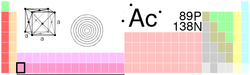
periodic table
|
|
|
| General |
|
Name, Symbol, Number |
actinium, Ac, 89 |
|
Chemical series |
actinides |
|
Group, Period, Block |
3, 7, f |
|
Appearance |
silvery |
|
Atomic mass |
(227) g/mol |
|
Electron configuration |
[ Rn] 6d1 7s2 |
| Electrons per shell |
2, 8, 18, 32, 18, 9, 2 |
| Physical properties |
|
Phase |
solid |
|
Density (near r.t.) |
10 g/cm³ |
|
Melting point |
(circa) 1323 K
(1050 ° C, 1922 ° F) |
|
Boiling point |
3471 K
(3198 ° C, 5788 ° F) |
|
Heat of fusion |
14 kJ/mol |
|
Heat of vaporization |
400 kJ/mol |
|
Heat capacity |
(25 °C) 27.2 J/(mol·K) |
| Atomic properties |
|
Crystal structure |
cubic face centered |
|
Oxidation states |
3
(neutral oxide) |
|
Electronegativity |
1.1 ( Pauling scale) |
|
Ionization energies |
1st: 499 kJ/mol |
| 2nd: 1170 kJ/mol |
|
Atomic radius |
195 pm |
| Miscellaneous |
|
Magnetic ordering |
no data |
|
Thermal conductivity |
(300 K) 12 W/(m·K) |
|
CAS registry number |
7440-34-8 |
| Notable isotopes |
Main article: Isotopes of actinium
|
iso |
NA |
half-life |
DM |
DE ( MeV) |
DP |
| 225Ac |
syn |
10 days |
α |
5.935 |
221 Fr |
| 226Ac |
syn |
29.37 hours |
β- |
1.117 |
226 Th |
|
ε |
0.640 |
226 Ra |
|
α |
5.536 |
222 Fr |
| 227Ac |
100% |
21.773 years |
β- |
0.045 |
227 Th |
|
α |
5.042 |
223 Fr |
|
|
References |
Actinium is a chemical element in the periodic table that has the symbol Ac and atomic number 89.
 Jump to Page Contents Jump to Page Contents
|
|

Pay as you go
No monthly charges. Access for the price of a phone call
Go>
Unmetered
Flat rate dialup access from only £4.99 a month Go>
Broadband
Surf faster from just £13.99 a month Go> |
Save Even More
Combine your phone and internet, and save on your phone calls
More Info> |
This weeks hot offer
 24: Series 5
In association with Amazon.co.uk £26.97 |
|
Contents
Notable characteristics
Applications
History
Occurrence
Isotopes
Precautions
Notable characteristics - Contents
Actinium is a silvery radioactive metallic element. Due to its intense radioactivity, Actinium glows in the dark with an eerie blue light. It is found only in traces in uranium ores as 227-Ac, an α and β emitter with a half-life of 21.773 years. One ton of uranium ore contains about a tenth of a gram of actinium.
Applications - Contents
It is about 150 times as radioactive as radium, making it valuable as a neutron source. Otherwise it has no significant industrial applications.Actinium-225 is used in medicine to produce Bi-213 in a reusable generator or can be used alone as an agent for radio-immunotherapy.
History - Contents
Actinium was discovered in 1899 by André-Louis Debierne, a French chemist, who separated it from pitchblende. Friedrich Otto Giesel independently discovered actinium in 1902. The chemical behaviour of actinium is similar to that of the rare earth lanthanum.The word actinium comes from the Greek aktis, aktinos, meaning beam or ray.
Occurrence - Contents
Actinium is found in trace amounts in uranium ore, but more commonly is made in milligram amounts by the neutron irradiation of 226-Ra in a nuclear reactor. Actinium metal has been prepared by the reduction of actinium fluoride with lithium vapor at about 1100 to 1300ºC.
Isotopes - Contents
Naturally occurring actinium is composed of 1 radioactive isotope; 227Ac. 36 radioisotopes have been characterized with the most stable being 227-Ac with a half-life of 21.772 y, 225-Ac with a half-life of 10.0 days, and 226-Ac with a half-life of 29.37 h. All of the remaining radioactive isotopes have half-lifes that are less than 10 hours and the majority of these have half lifes that are less than 1 minute. The shortest-lived isotope of actinium is217Ac which decays through alpha decay and electron capture. It has a half-life of 69 ns. Actinium also has 2 meta states.Purified actinium-227 comes into equilibrium with its decay products at the end of 185 days, and then decays according to its 21.773-year half-life.The isotopes of actinium range in atomic weight from 206 amu (206actinium) to 236 amu (236Ac).
Precautions - Contents
Actinium-227 is extremely radioactive, and in terms of its potential for radiation induced health effects, actinium-227 is about as dangerous as plutonium. Ingesting even small amounts of actinium-227 would present a serious health hazard. |
Change Text Size:
[A]
[default]
[A] |



 |
|
|
|
|

