 |
|
|
|
Mon, 14 Sep, 2026
|

|

|
|
? Anteater |
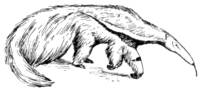
Giant Anteater
|
| Scientific classification |
|
|
|
|
|
Genera
|
Myrmecophaga
Tamandua
Cyclopes
|
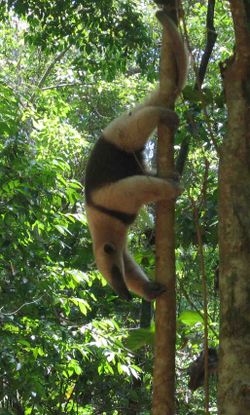 A Tamandua anteater in Costa Rica
Photograph by Dirk van der Made
Anteaters are mammals of 4 species of the order Xenarthra and the family Myrmecophagidae, commonly known for eating ants and termites.
 Jump to Page Contents Jump to Page Contents
|
|

Pay as you go
No monthly charges. Access for the price of a phone call
Go>
Unmetered
Flat rate dialup access from only £4.99 a month Go>
Broadband
Surf faster from just £13.99 a month Go> |
Save Even More
Combine your phone and internet, and save on your phone calls
More Info> |
This weeks hot offer
 24: Series 5
In association with Amazon.co.uk £26.97 |
|
Contents
Physiology
Family order
Anteaters as Mascots
Physiology - Contents
The largest representative of the group is the Giant Anteater or Ant-bear (Myrmecophaga tridactyla or jubata), an animal measuring 4 feet (1.2 m) in length without the tail, and 2 feet (60 cm) in height at the shoulder. It has a long, thin head and a large, bushy tail. Its prevailing colour is grey, with a broad black band, bordered with white, starting on the chest, and passing obliquely over the shoulder, diminishing gradually in breadth as it approaches the loins, where it ends in a point.It is extensively distributed in the tropical parts of South and Central America, frequenting low swampy savannas, along the banks of rivers, and the depths of the humid forests, but is nowhere abundant.Its food consists mainly of termites, which it obtains by opening their nests with its powerful sharp anterior (front) claws. As the insects swarm to the damaged part of their dwelling, it draws them into its mouth by means of its long, flexible, rapidly moving tongue covered with sticky saliva.The Giant Anteater lives above ground, not burrowing underground like armadillos. Though generally an inoffensive animal, when attacked it can defend itself with its sabre-like anterior claws. The female produces one offspring per birth.The two tamandua anteaters, as typified by Tamandua (or Uroleptes) tetradactyla, are much smaller than the Giant Anteater, and differ essentially from it in their habits, being mainly arboreal. They inhabit the dense primeval forests of South and Central America. The usual colour is yellowish-white, with a broad black lateral band, covering nearly the whole of the side of the body.The little or two-toed or Silky Anteater (Cyclopes or Cyclotorus didactylus) is a native of the hottest parts of South and Central America, and about the size of a rat, of a general yellowish colour, and exclusively arboreal in its habits.
Family order - Contents
- ORDER XENARTHRA
- Family Myrmecophagidae
- Silky Anteater, Cyclopes didactylus
- Giant Anteater, Myrmecophaga tridactyla
- Northern Tamandua, Tamandua mexicana
- Southern Tamandua, Tamandua tetradactyla
- Family Megalonychidae: two toed sloths
- Family Bradypodidae: three toed sloths
- Family Dasypodidae: armadillos
Similar animals
-
Pangolins are also called scaly anteaters.
- The Numbat (Myrmecobius fasciatus), a marsupial, formerly called the Banded Anteater.
-
Echidnas, a family of monotremes, are still sometimes called spiny anteaters.
- Aardvarks are African animals with similar habits.
Anteaters as Mascots - Contents
The Anteater is the mascot of the University of California, Irvine. |
Change Text Size:
[A]
[default]
[A] |



 |
|
|
|
|

