 |
|
|
|
Mon, 14 Sep, 2026
|

|
|

Pay as you go
No monthly charges. Access for the price of a phone call
Go>
Unmetered
Flat rate dialup access from only £4.99 a month Go>
Broadband
Surf faster from just £13.99 a month Go> |
Save Even More
Combine your phone and internet, and save on your phone calls
More Info> |
This weeks hot offer
 24: Series 5
In association with Amazon.co.uk £26.97 |
|
|
? Arachnid |
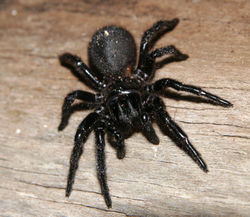
Victorian Funnelweb Spider
|
| Scientific classification |
| Kingdom: |
Animalia
|
| Phylum: |
Arthropoda
|
| Class: |
Arachnida
Cuvier, 1812 |
|
|
|
|
|
|
Orders
|
Acarina
Amblypygi
Araneae
Opiliones
Palpigradi
Pseudoscorpionida
Ricinulei
Schizomida
Scorpiones
Solifugae
Uropygi
|
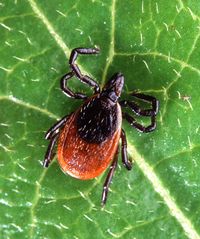 Adult deer tick.
The arachnids, Arachnida, are a class of joint-legged invertebrate animals in the subphylum Chelicerata. Arachnids are named for the mythological figure Arachne. They are chiefly terrestrial arthropods, some 65,000 to 73,000 species including the spiders, scorpions, harvestmen, ticks, and mites. The arachnids are easily distinguished from the insects by the fact that they have eight legs instead of six. The pedipalpi (leg-like mouthparts) of some species has instead been adapted for sensory, prey capture or reproductive functions. In solifugae the palpi are quite leg-like and make solifugae appear to have ten legs. Larval mites have only six legs: they grow their fourth pair when they molt into nymphs.Arachnids are further distinguished by the fact they have no antennae and no wings. They have a two-segment body, made up merely of the thorax and abdomen.Arachnids are mostly carnivorous, feeding on the pre-digested bodies of insects and other small animals. Many are venomous - they secrete poison from specialized glands to kill prey or enemies. Others are parasites, some of which are carriers of disease. Arachnids usually lay eggs, which hatch into immature adults.
 Orders - Contents Orders - Contents
-
Amblypygi - "Blunt rump" tailless whip scorpions with front legs modified into whip-like sensory structures as long as 25 cm or more
-
Araneae - Spiders (40,000 species)
-
Mesothelae - very rare, primitive spiders
-
Opisthothelae - all spiders except mesothelae
-
Araneomorphae - most common spiders
-
Mygalomorphae - tarantulas and tarantula-like spiders
-
Opiliones - Phalangids, harvestmen or daddy longlegs (6,300 species)
-
Palpigradi - Microwhip scorpions
-
Pseudoscorpionida - Pseudoscorpions
-
Ricinulei - Ricinuleids, Hooded tickspiders
-
Schizomida - "Split middle" whip scorpions with divided exoskeletons
-
Scorpiones - Scorpions (2,000 species)
-
Solifugae - Solipugids; windscorpions, sun spiders or camel spiders (900 species)
-
Uropygi - whip scorpions, with first legs modified as whip-like sensory organs and with a long thin tail at end of abdomen (60 species)
-
Acarina - Mites and ticks (30,000 species)
-
Acariformes
-
Sarcoptiformes
-
Trombidiformes
-
Opilioacariformes
-
Parasitiformes - Holothyrans, ticks and mesostigmatic mites
Also see the following articles for links to species by common name:
-
List of scorpion common names
-
List of spider common names
-
List of false scorpions
|
Change Text Size:
[A]
[default]
[A] |



 |
|
|
|
|


