 |
|
|
|
Mon, 14 Sep, 2026
|

|
|

Pay as you go
No monthly charges. Access for the price of a phone call
Go>
Unmetered
Flat rate dialup access from only £4.99 a month Go>
Broadband
Surf faster from just £13.99 a month Go> |
Save Even More
Combine your phone and internet, and save on your phone calls
More Info> |
This weeks hot offer
 24: Series 5
In association with Amazon.co.uk £26.97 |
|
For other articles titled "Bongo" refer to the disambiguation page.
|
? Bongo
Conservation status: Endangered
|
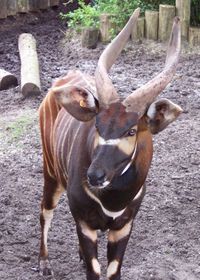
A Bongo, courtesy of Animal Portal
|
| Scientific classification |
| Kingdom: |
Animalia
|
| Phylum: |
Chordata
|
| Class: |
Mammalia
|
| Order: |
Artiodactyla
|
| Family: |
Bovidae
|
| Subfamily: |
Bovinae
|
| Genus: |
Tragelaphus
|
| Species: |
T. eurycerus
|
|
|
|
|
|
|
|
Tragelaphus eurycerus
( Ogilby, 1837) |
|
|
The Bongo is a type of antelope that lives in rain forests in Central, East, and West Africa. Its scientific name is Tragelaphus eurycerus, in the subgenus boocerus, which is sometimes made a full genus. The bongo has red-brown fur with a black belly and white stripes on its sides. It has white spots on its cheeks and a ridge of fur along its back. It has large ears and can weigh as much as 900 pounds (400 kg). Both male and female bongos have spiral horns.Bongos eat an herbivorous diet including bamboo and shrubs. Leopards, spotted hyenas, lions, and humans prey on them; pythons sometimes eat bongo calves.Bongos are mainly nocturnal and easily startled. Bongo populations have been greatly reduced by hunting and snares, although some bongo refuges exist. |
Change Text Size:
[A]
[default]
[A] |



 |
|
|
|
|


