 |
|
|
|
Mon, 14 Sep, 2026
|

|
|

Pay as you go
No monthly charges. Access for the price of a phone call
Go>
Unmetered
Flat rate dialup access from only £4.99 a month Go>
Broadband
Surf faster from just £13.99 a month Go> |
Save Even More
Combine your phone and internet, and save on your phone calls
More Info> |
This weeks hot offer
 24: Series 5
In association with Amazon.co.uk £26.97 |
|
|
? Caper |
|
| Scientific classification |
| Kingdom: |
Plantae
|
| Division: |
Magnoliophyta
|
| Class: |
Magnoliopsida
|
| Order: |
Caryophyllales
|
| Family: |
Capparaceae
|
| Genus: |
Capparis
|
| Species: |
C. spinosa
|
|
|
|
|
|
|
|
Capparis spinosa
Linnaeus, 1753 |
|
|
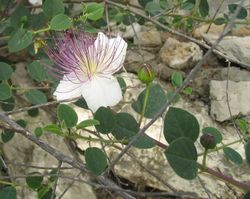
A Caper (Capparis spinosa) is a shrub from the Mediterranean region. It is best known for its edible buds and fruit which are usually consumed pickled.
 Culinary uses - Contents Culinary uses - Contents
The pickled or salted caper bud (also called caper) is often used as a seasoning or garnish. Capers are a common ingredient in Mediterranean cuisine. The grown fruit of the caper shrub is also available, prepared similarly to the buds, as caper berries.The berries, when ready to pick, are a dark olive green and about the size of a kernel of maize. They are picked and then pickled in a vinegar and salt solution.Capers are often enjoyed in cold smoked salmon or cured salmon dishes, salad, pizza, pasta and sauces.It was used in ancient Greece as a carminative. The caper-berry is mentioned in the Bible in the book of Ecclesiastes as "avionah" according to modern interpretation of the word.
Additional information - Contents
-
Gernot Katzer's Spice Dictionary — Caper
-
Caper factsheet — NewCROP, Purdue University
|
Change Text Size:
[A]
[default]
[A] |



 |
|
|
|
|


