 |
|
|
|
Mon, 14 Sep, 2026
|

|
|

Pay as you go
No monthly charges. Access for the price of a phone call
Go>
Unmetered
Flat rate dialup access from only £4.99 a month Go>
Broadband
Surf faster from just £13.99 a month Go> |
Save Even More
Combine your phone and internet, and save on your phone calls
More Info> |
This weeks hot offer
 24: Series 5
In association with Amazon.co.uk £26.97 |
|
|
? Cichorium |
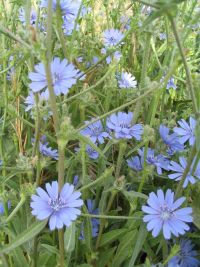
Wild endive (Cichorium pumilum)
|
| Scientific classification |
| Kingdom: |
Plantae
|
| Division: |
Magnoliophyta
|
| Class: |
Magnoliopsida
|
| Order: |
Asterales
|
| Family: |
Asteraceae
|
| Genus: |
Cichorium
|
|
|
|
|
|
|
Species
|
- C. endivia - cultivated endive
- C. pumilum - wild endive
- C. intybus - common chicory
|
Chicory is the common name given to the flowering plants in genus Cichorium of the family Asteraceae. There are two cultivated species, and four to six wild species.Common chicory (Cichorium intybus) is a bushy perennial herb with blue or lavender flowers. It is originally from the Old World and was naturalized in North America, where it has become a roadside weed. The roots are baked, ground, and used as a coffee substitute in the plant's Mediterranean region of origin. Common chicory is also known as blue sailors, succory, and coffeeweed. The plant is cultivated and used as endive under the common names radicchio, Belgian endive, French endive, or witloof. It is grown in complete darkness to keep new leaves tender and pale.True endive (Cichorium endivia) is a species of chicory which is specially grown and used as a salad green. It has a slightly bitter taste and has been attributed with herbal properties. Curly endive and the broad-leafed escarole are true endives.Cichorium is used as a food plant by the larvae of some Lepidoptera species including Setaceous Hebrew Character and Turnip Moth.Root chicory (Chicorium intybus var. sativum ) has been grown since the Middle Age as a coffee substitute. Around 1970 it was found that the root contains up to 20% inulin. Since then, new strains have been created, giving root chicory an inulin content comparable to that of sugar beet (around 600 dt/ha). Inulin is mainly present in the plant family Asteraceae as a storage carbohydrate (for example Jerusalem artichoke, dahlia, etc.). It is used as a sweetener in the food industry (with a sweetening power 30% higher than that of sucrose). Inulin can be converted to fructose and glucose through hydrolysis. |
Change Text Size:
[A]
[default]
[A] |



 |
|
|
|
|


