 |
|
|
|
Tue, 15 Sep, 2026
|

|
|

Pay as you go
No monthly charges. Access for the price of a phone call
Go>
Unmetered
Flat rate dialup access from only £4.99 a month Go>
Broadband
Surf faster from just £13.99 a month Go> |
Save Even More
Combine your phone and internet, and save on your phone calls
More Info> |
This weeks hot offer
 24: Series 5
In association with Amazon.co.uk £26.97 |
|
|
? Clove |
|
| Scientific classification |
| Kingdom: |
Plantae
|
| Division: |
Magnoliophyta
|
| Class: |
Magnoliopsida
|
| Order: |
Myrtales
|
| Family: |
Myrtaceae
|
| Genus: |
Syzygium
|
| Species: |
S. aromaticum
|
|
|
|
|
|
|
|
Syzygium aromaticum
( L.) Merrill & Perry |
|
|
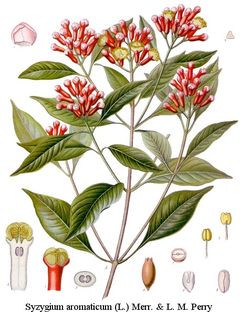
Cloves (Syzygium aromaticum, syn. Eugenia aromaticum) are the aromatic dried flower buds of a tree in the family Myrtaceae. It is native to Indonesia and used as a spice in virtually all the world's cuisine. The name derives from French clou, a nail, as the buds vaguely resemble small irregular nails in shape. Cloves are harvested primarily in Indonesia and Madagascar; it is also grown in Zanzibar, India, Sri Lanka, and the "Spice Islands" ( Moluccas, Indonesia known as the Bandas Islands).The clove tree is an evergreen which grows to a height ranging from 10-20 m, having large oval leaves and crimson flowers in numerous groups of terminal clusters. The flower buds are at first of a pale colour and gradually become green, after which they develop into a bright red, when they are ready for collecting. Cloves are harvested when 1.5-2 cm long, and consist of a long calyx, terminating in four spreading sepals, and four unopened petals which form a small ball in the centre.
Uses
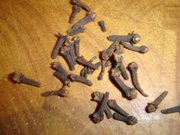 Dried cloves
Cloves can be used in cooking either whole or in a ground form, but as they are extremely strong they are used sparingly. The spice is used throughout Europe and Asia and is smoked in cigarettes (also known as kreteks) in Indonesia and in occasional coffee bars in the West, mixed with marijuana to create marijuana spliffs. Cloves are also an important incense material in Chinese and Japanese culture. Clove essential oil is used in aromatherapy and oil of cloves is widely used to treat toothache in dental emergencies.
History
In the 4th century BC, Chinese leaders in the Han Dynasty required those who addressed them to chew cloves so as to freshen their breath. Cloves, along with nutmeg and pepper, were highly prized in Roman times, and Pliny the Elder once famously complained that "there is no year in which India does not drain the Roman Empire of fifty million sesterces". Cloves were traded by Arabs during the Middle Ages in the profitable Indian Ocean trade. In the late 15th century, Portugal took over the Indian Ocean trade, including cloves, due to the Treaty of Tordesillas with Spain and a separate treaty with the sultan of Ternate. The Portuguese brought large quantities of cloves to Europe, mainly from the Maluku Islands. Clove was then one of the most valuable spices, a kg of which costing around 7 g of gold.The trade later became dominated by the Dutch in the 17th century. With great difficulty the French succeeded in introducing the clove tree into Mauritius in the year 1770; subsequently the cultivation was introduced into Guiana, Brazil, most of the West Indies, and Zanzibar, where the majority of cloves today are grown.In Britain in the 17th and 18th centuries, cloves were worth at least their weight in gold, due to the high price of import.
Active compounds
The essential oil of cloves has anesthetic and antimicrobial qualities, and is sometimes used to eliminate bad breath or to ameliorate the pain of a bad tooth. It, or its main component eugenol, is used by dentists to calm the nerve inside a tooth after the removal of deep decay, and is the characteristic odour of a dentist's office. Clove oil is used in the traditional blend of choji (1% clove oil in mineral oil) and is applied to Japanese sword blades to prevent tarnishing of the polished surface.
|
Change Text Size:
[A]
[default]
[A] |



 |
|
|
|
|


