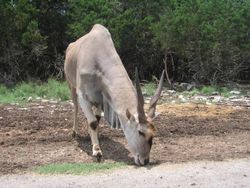
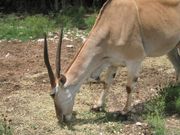
The Common Eland (Taurotragus oryx) is a savannah and plain antelope found in East and Southern Africa.The Common Eland stands around two metres at the shoulder and weighs 300 kilograms to a tonne. Common Eland females have a tan coat while the males' coat is a darker tan with a blue tinge to it, there may be a single white stripe vertically placed on the sides. The males have dense fur on their foreheads and a large dewlap. Both sexes have horns, which are about 65 centimetres long and almost straight. The horns of the female are longer but thinner than those of the male.Common Eland live on the savannah and eat grass, branches and leaves. They are diurnal but tend towards inactivity during the heat of the day. Herds are usually between thirty and eighty individuals but are known to reach upwards of four hundred. The Common Eland has an unusual social life. They come and go, taking advantage of herd life when they need to without forming close ties.They "are very agile and can easily jump a 1.5m fence from a standing start" (sign from Western Plains Zoo, Dubbo, NSW, Australia).Common Eland are sometimes considered part of the genus Tragelaphus but it is usually catagorised as Taurotragus with the Giant Eland.