 |
|
|
|
Thu, 01 Oct, 2026
|

|

|
|
? Cookiecutter shark |
Cookiecutter shark
|
| Scientific classification |
| Kingdom: |
Animalia
|
| Subkingdom: |
Deuterostomia
|
| Phylum: |
Chordata
|
| Class: |
Chondrichthyes
|
| Order: |
Squaliformes
|
| Family: |
Dalatiidae
|
| Genus: |
Isistius
|
| Species: |
I. brasiliensis
|
|
|
|
|
|
|
|
Isistius brasiliensis
( Quoy & Gaimard, 1824) |
|
|
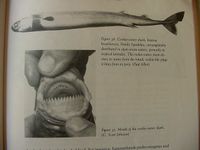
The Cookiecutter shark, Isistius brasiliensis (also known as the Cigar shark or Luminous shark) is a small rarely-seen dogfish shark. It gets its name from its feeding style which often creates perfect "cookie-cutter" shaped plugs in the skin of large marine mammals and other large sharks.
 Jump to Page Contents Jump to Page Contents
|
|

Pay as you go
No monthly charges. Access for the price of a phone call
Go>
Unmetered
Flat rate dialup access from only £4.99 a month Go>
Broadband
Surf faster from just £13.99 a month Go> |
Save Even More
Combine your phone and internet, and save on your phone calls
More Info> |
This weeks hot offer
 24: Series 5
In association with Amazon.co.uk £26.97 |
|
Contents
Physical Characteristics
Distribution
Habits and Habitat
Physical Characteristics - Contents
The cookiecutter sharks often glows green and grows up to 50 cm (20 in) long. The underside of the shark is bioluminescent, glowing a pale blue-green that matches the background light from the ocean's surface that serves as camouflage to creatures beneath it. However, a small non-luminescent patch appears black, deceiving the shark's prey, smaller predatory fish (like tuna), into thinking the shark is an even smaller fish. When the predatory fish tries to strike at the shark, the shark strikes back, scoring itself another meal [1]. This is the only known instance whereby a bioluminescent lure is created by the absence of luminescence (contrast with anglerfish).
Distribution - Contents
Worldwide in deepwater.
Habits and Habitat - Contents
The cookiecutter shark has been found at depths of about 1,000 m (3,300 ft) below the surface of the ocean. It derived its name from its habit of removing small circular chunks of flesh from whales and large fish. It is hypothesized that the shark seizes its much larger prey with its jaws, then rotates its body to achieve a highly symmetrical cut. They are considered a parasite. Cookiecutter sharks reproduce through aplacental viviparity in the same way as great white sharks. Little else is known about their reproduction. |
Change Text Size:
[A]
[default]
[A] |



 |
|
|
|
|

