 |
|
|
|
Mon, 14 Sep, 2026
|

|
|

Pay as you go
No monthly charges. Access for the price of a phone call
Go>
Unmetered
Flat rate dialup access from only £4.99 a month Go>
Broadband
Surf faster from just £13.99 a month Go> |
Save Even More
Combine your phone and internet, and save on your phone calls
More Info> |
This weeks hot offer
 24: Series 5
In association with Amazon.co.uk £26.97 |
|
|
? Damselflies |
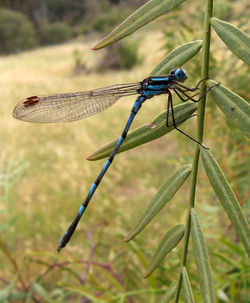
Common Blue Damselfly (Enallagama cyathigerum)
|
| Scientific classification |
| Kingdom: |
Animalia
|
| Phylum: |
Arthropoda
|
| Class: |
Insecta
|
| Order: |
Odonata
|
| Suborder: |
Zygoptera
Selys, 1854 |
|
|
|
|
|
|
Families
|
Amphipterygidae
Calopterygidae- Demoiselles
Chlorocyphidae- Jewels
Dicteriadidae- Barelegs
Euphaeidae- Gossamerwings
Polythoridae- Bannerwings
Synlestidae- Sylphs
Lestidae- Spreadwings
Lestoididae
Megapodagrionidae- Flatwings
Perilestidae- Shortwings
Hemiphlebidae- Reedlings
Coenagrionidae- Pond Damselflies
Isosticidae- Narrow-wings
Platycnemidae- Brook Damselflies
Platystictidae- Forest Damselflies
Protoneuridae- Pinflies
Pseudostigmatidae- Forest Giants
|
The Damselfly (Suborder Zygoptera) is an insect in the Order Odonata. Damselflies are similar to dragonflies, but the adults can be differentiated by the fact that the wings of most damselflies are held along the body when at rest. Damselflies are also usually smaller, and weaker fliers than dragonflies, and their eyes are separated.
 Biology - Contents Biology - Contents
Damselflies undergo incomplete metamorphosis. The female lays eggs in water, sometimes in underwater vegetation. Nymphs are carnivorous, feeding on daphnia, mosquito larvae, and other small aquatic organisms. After molting a couple of times, the adult emerges and eats flies, mosquitoes, and other small insects.
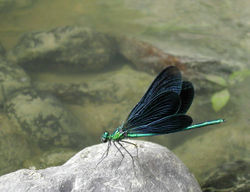
Beautiful Demoiselle
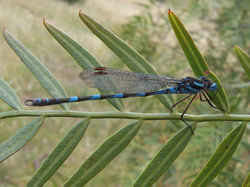 Common Blue Damselfly
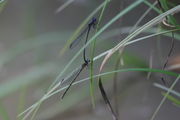 Mating Damselflies
|
Change Text Size:
[A]
[default]
[A] |



 |
|
|
|
|


