 |
|
|
|
Mon, 14 Sep, 2026
|

|

|
| Bolivia in topic |
Economy
History
Politics
Geography
Demographics
Culture
Religion
Education
Tourism
Transportation
Communications
Military
Foreign relations
|
Bolivia's ethnic distribution is estimated to be 56%-70% indigenous people and 30%-42% European and mixed. The largest of the approximately three dozen indigenous groups are the Aymara, Quechua, and Guarani. There are small German, former Yugoslav, Asian (notably Japanese : Okinawans relocated there after expropriation of farmland by the U.S. military after WWII : [1]), Middle Eastern, and other minorities, many of whose members descend from families that have lived in Bolivia for several generations.Bolivia is one of the least-developed countries in South America. About two-thirds of its people, many of whom are subsistence farmers, live in poverty. Population density ranges from less than one person per square kilometer in the southeastern plains to about 10 per square km. (25 per sq. mi.) in the central highlands. Bolivia's high mortality rate restricts the annual population growth rate to around 1.96% (1999).La Paz is at the highest elevation of the world's capital cities--3,600 meters (11,800 ft.) above sea level. The adjacent city of El Alto, at 4,200 meters above sea level, is one of the fastest-growing in the hemisphere. Santa Cruz, the commercial and industrial hub of the eastern lowlands, also is experiencing rapid population and economic growth.The great majority of Bolivians are Roman Catholic (the official religion), although Protestant denominations are expanding strongly. Many indigenous communities interweave pre-Columbian and Christian symbols in their religious practices. About half of the people speak Spanish as their first language. Approximately 90% of the children attend primary school but often for a year or less. The literacy rate is low in many rural areas.
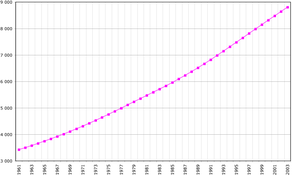 Demographics of Bolivia, Data of FAO, year 2005 ; Number of inhabitants in thousands.
The cultural development of what is present-day Bolivia is divided into three distinct periods: pre-Columbian, colonial, and republican. Important archaeological ruins, gold and silver ornaments, stone monuments, ceramics, and weavings remain from several important pre-Columbian cultures. Major ruins include Tiwanaku, Samaipata, Incallajta, and Iskanwaya. The country abounds in other sites that are difficult to reach and hardly explored by archaeologists.The Spanish brought their own tradition of religious art which, in the hands of local indigenous and mestizo builders and artisans, developed into a rich and distinctive style of architecture, painting, and sculpture known as "Mestizo Baroque." The colonial period produced not only the paintings of Perez de Holguin, Flores, Bitti, and others but also the works of skilled, but unknown, stonecutters, woodcarvers, goldsmiths, and silversmiths. An important body of native baroque religious music of the colonial period was recovered in recent years and has been performed internationally to wide acclaim since 1994. Bolivian artists of stature in the 20th century include, among others, Guzman de Rojas, Arturo Borda, Maria Luisa Pacheco, and Marina Nunez del Prado.Bolivia has rich folklore. Its regional folk music is distinctive and varied. The devil dances at the annual carnival of Oruro are one of the great folkloric events of South America, as is the lesser known carnival at Tarabuco.
 Jump to Page Contents Jump to Page Contents
|
|

Pay as you go
No monthly charges. Access for the price of a phone call
Go>
Unmetered
Flat rate dialup access from only £4.99 a month Go>
Broadband
Surf faster from just £13.99 a month Go> |
Save Even More
Combine your phone and internet, and save on your phone calls
More Info> |
This weeks hot offer
 24: Series 5
In association with Amazon.co.uk £26.97 |
|
Contents
Demographic data from the CIA World Factbook
Demographic data from the CIA World Factbook - Contents
Population
- 8,857,870 (July 2005 est.)
Age structure
- 0-14 years: 35.7% (male 1,613,049/female 1,551,023)
- 15-64 years: 59.8% (male 2,591,328/female 2,701,892)
- 65 years and over: 4.5% (male 178,486/female 222,092) (2005 est.)
Median age
- Total: 21.47 years
- Male: 20.79 years
- Female: 22.17 years (2005 est.)
Population growth rate
- 1.49% (2005 est.)
Birth rate
- 23.76 births/1,000 population (2005 est.)
Death rate
- 7.64 deaths/1,000 population (2005 est.)
Net migration rate
- -1.27 migrant(s)/1,000 population (2005 est.)
Sex ratio
- At birth: 1.05 male(s)/female
- Under 15 years: 1.04 male(s)/female
- 15-64 years: 0.96 male(s)/female
- 65 years and over: 0.8 male(s)/female
- Total population: 0.98 male(s)/female (2005 est.)
Infant mortality rate
- Total: 53.11 deaths/1,000 live births
- Male: 56.7 deaths/1,000 live births
- Female: 49.33 deaths/1,000 live births (2005 est.)
Life expectancy at birth
- Total population: 65.5 years
- Male: 62.89 years
- Female: 68.25 years (2005 est.)
Total fertility rate
- 2.94 children born/woman (2005 est.)
HIV/AIDS
- Adult prevalence rate: 0.1% (2003 est.)
- People living with HIV/AIDS: 4,900 (2003 est.)
- Deaths: less than 500 (2003 est.)
Nationality
- Noun: Bolivian(s)
- Adjective: Bolivian
Ethnic groups
- Quechua 30%, mestizo (mixed white and Amerindian ancestry) 30%, Aymara 25%, white 15%
Religions
- Roman Catholic 95%, Protestant (Evangelical Methodist) 5%
Languages
- Spanish (official), Quechua (official), Aymara (official)
Literacy
- Definition: age 15 and over can read and write
- Total population: 87.2%
- Male: 93.1%
- Female: 81.6% (2003 est.)
|
Change Text Size:
[A]
[default]
[A] |



 |
|
|
|
|

