 |
|
|
|
Tue, 15 Sep, 2026
|

|

|
|
? Earwigs |
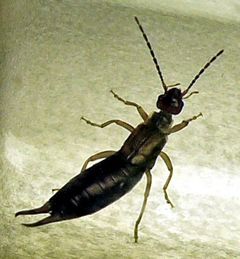
Female (no hooked cerci)
|
| Scientific classification |
| Kingdom: |
Animalia
|
| Phylum: |
Arthropoda
|
| Class: |
Insecta
|
| Subclass: |
Pterygota
|
| Infraclass: |
Neoptera
|
| Superorder: |
Exopterygota
|
| Order: |
Dermaptera
De Geer, 1773 |
|
|
|
|
|
|
Families
|
Suborder Archidermaptera
- extinct
Suborder Forficulina
-
Pygidicranidae
-
Diplatyidae
-
Anisolabididae
-
Labiduridae
-
Apachyidae
-
Spongiphoridae
-
Chelisochidae
-
Forficulidae
Suborder Hemimerina
-
Hemimeridae
Suborder Arixenina
-
Arixeniidae
|
The order (Dermaptera) of insects characterized by large membraneous wings folded underneath short leathery forewings (thus the literal name of the order - "skin wings"). The abdomen extends well beyond the wings, and frequently, though not always, ends in a pair of forceps-like cerci. With about 1,800 recorded species in 10 families, the order is relatively small among the Insecta, but the earwigs themselves are quite common throughout the world, often finding their way into houses, where they are usually first noticed scurrying across the floor.
 Jump to Page Contents Jump to Page Contents
|
|

Pay as you go
No monthly charges. Access for the price of a phone call
Go>
Unmetered
Flat rate dialup access from only £4.99 a month Go>
Broadband
Surf faster from just £13.99 a month Go> |
Save Even More
Combine your phone and internet, and save on your phone calls
More Info> |
This weeks hot offer
 24: Series 5
In association with Amazon.co.uk £26.97 |
|
Contents
Etymology
Physiology
Etymology - Contents
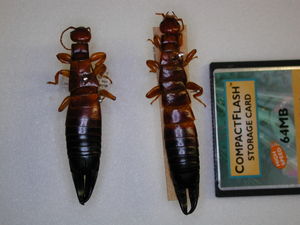 Earwig from Australia - 63 mm
The name "earwig" is generally said to originate from an old belief that earwigs crawl into people's ears and lay eggs in the brain. This etymology is given by the Oxford English Dictionary, which states unequivocally that the name is derived from Old English éare, "ear", and wicga, "earwig", "from the notion that it penetrates into the head through the ear." Earwigs do tend to prefer being in hidden places, and this etymology parallels the unambiguous French name perce-oreille ("ear piercer"). Another hypothesis is that the word comes from the Late Latin auricula, owing to the ancient use of pulverized earwigs as medicine to treat diseases of the ear. A third explanation is that it is an alteration of "ear-wing", after the shape of the hind wings when unfolded.
Physiology - Contents
 Common earwig, Forficula auricularia
Most earwigs are elongated and low to the ground, and are dark brown in colour. Lengths are mostly in the 10-14 mm range, with a species of St Helena reaching 80 mm. The cerci range from nonexistent, to long arcs up to 1/3 as long as the rest of the body. Mouthparts are adapted for chewing. The hindwings are folded in a complicated fashion so that they fit under the forewings, but despite this complex design, earwigs rarely fly.The earwig's abdomen is flexible and muscular, and capable of both maneuvering and opening/closing the forceps. The forceps seem to be used for a variety of purposes. Their role in self-defense is familiar to every child whose first grab at a passing earwig resulted in a pinch—more surprising than painful, the forceps not being particularly strong. In some species, the forceps have also been observed in use for holding prey, to unfold the wings, and in copulation. There is also conclusive proof that earwig males grow a spare set of genitals in the event of their first set being snapped off or otherwise damaged.Fossil earwigs are known from the Jurassic period (between 200 and 150 million years ago) --about 70 specimens having been found as of 2003. |
Change Text Size:
[A]
[default]
[A] |



 |
|
|
|
|

