 |
|
|
|
Tue, 15 Sep, 2026
|

|
|

Pay as you go
No monthly charges. Access for the price of a phone call
Go>
Unmetered
Flat rate dialup access from only £4.99 a month Go>
Broadband
Surf faster from just £13.99 a month Go> |
Save Even More
Combine your phone and internet, and save on your phone calls
More Info> |
This weeks hot offer
 24: Series 5
In association with Amazon.co.uk £26.97 |
|
|
? Epazote |
|
| Scientific classification |
| Kingdom: |
Plantae
|
| Division: |
Tracheobionta
|
| Class: |
Magnoliopsida
|
| Order: |
Caryophyllales
|
| Family: |
Chenopodiaceae
|
| Genus: |
Chenopodium
|
| Species: |
C. ambrosioides
|
|
|
|
|
|
|
|
Chenopodium ambrosioides
L. |
|
|
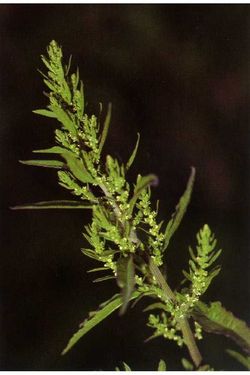
Epazote or Mexican Tea (Chenopodium ambrosioides) is a herb native to Central America and southern Mexico. It is an annual or short-lived perennial plant, growing to 1.2 m tall, irregularly branched, with oblong-lanceolate leaves up to 12 cm long. The flowers are small and green, produced in a branched panicle at the apex of the stem.As well as in its native area, it is grown in warm temperate to subtropical areas of Europe and the United States, sometimes becoming an invasive weed.
 Culinary uses - Contents Culinary uses - Contents
Epazote is used as a leaf vegetable and herb for its pungent flavor and its claimed ability to prevent flatulence caused by eating beans. Raw, it has a resinous, medicinal pungency, a bit like the liquorice taste of anise, fennel, or even tarragon, but stronger. Epazote's fragrance is strong, but difficult to describe. People would often compare it with (in no particular order) citrus, petroleum, savory, mint or putty.Its name comes from the * Nahuatl: language. it means epatli= skunk + zotli= herb "skunk herb"
Medicinal uses - Contents
Oil of Chenopdium is derived from this plant. It is anthelmintic, that is it kills intestinal worms, and was once listed for this use in the US Pharmacopoeia. It is also cited as an antispasmodic and abortifacient - the first birth control pills were derived from research on epazote.Epazote essential oil contains ascaridole (up to 70%), limonene, p-cymene, and smaller amounts of numerous other monoterpenes and monoterpene derivatives ( α-pinene, myrcene, terpinene, thymol, camphor and trans-isocarveol). Ascaridol (1,4-peroxido-p-menth-2-ene) is rather an uncommon constituent of spices; another plant owing much of its character to this monoterpene peroxide is boldo. Ascaridole is toxic and has a pungent, not very pleasant flavor; in pure form, it is an explosive sensitive to shock. Allegedly, ascaridole content is lower in epazote from México than in epazote grown in Europe or Asia. |
Change Text Size:
[A]
[default]
[A] |



 |
|
|
|
|


