 |
|
|
|
Wed, 16 Sep, 2026
|

|
|

Pay as you go
No monthly charges. Access for the price of a phone call
Go>
Unmetered
Flat rate dialup access from only £4.99 a month Go>
Broadband
Surf faster from just £13.99 a month Go> |
Save Even More
Combine your phone and internet, and save on your phone calls
More Info> |
This weeks hot offer
 24: Series 5
In association with Amazon.co.uk £26.97 |
|
|
? Fireflies |
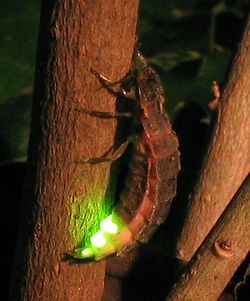
Lampyris noctiluca
|
| Scientific classification |
| Kingdom: |
Animalia
|
| Phylum: |
Arthropoda
|
| Class: |
Insecta
|
| Order: |
Coleoptera
|
| Suborder: |
Polyphaga
|
| Infraorder: |
Elateriformia
|
| Superfamily: |
Elateroidea
|
| Family: |
Lampyridae
Latreille, 1817 |
|
|
|
|
|
|
Genera
|
Curtos
Cyphonocerus
Drilaster
Ellychnia
Hotaria
Lampyris
Lucidina
Luciola- (Japanese fireflies)
Photinus- (common eastern firefly)
Photuris
Pristolycus
Pyractomena
Pyrocoelia
Stenocladius
|
Fireflies ( family Lampyridae), also known as lightningbugs, are nocturnal, luminous beetles. These names come from the fact that some species as adults emit flashes of light to attract mates, using special light-emitting organs in the abdomen. The enzyme luciferase acts on the substrate luciferin to stimulate light emission. This reaction is of scientific interest, and genes coding for these substances have been spliced into many different organisms.Many species, especially in the genus Photinus, are distinguished by the unique courtship flash patterns emitted by flying males as they search for females. Photinus females generally do not fly, but give a flash response to males of their own species.Many species of lampyrid beetles do not glow as adults, but they all glow as larvae. The larvae of fireflies are generally known as glowworms (but see Phengodidae). Bioluminescence serves a different function in lampyrid larvae than it does in adults. Larval bioluminescence appears to be a warning signal to predators, since many firefly larvae contain chemicals that are distasteful or toxic.There are more than 2000 species of firefly, found in temperate and tropical environments around the world.The ancient Chinese sometimes captured fireflies in transparent or semi-transparent containers and used them as (short-term) lanterns.
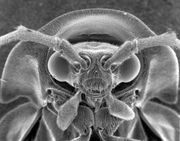
Scanning electron microscope image of a firefly
 Life Cycle/Overwintering - Contents Life Cycle/Overwintering - Contents
Fireflies overwinter (sometimes for several years, depending on the species) during the larval stage by burrowing underground and emerge in the spring. After several weeks of feeding, they pupate for 2-2.5 weeks and emerge as adults.A few days after mating, a fertilized female will lay her eggs on or just below the surface of the ground. The eggs will hatch in 3-4 weeks and the larva will feed until the end of the summer when they will burrow underground to overwinter. |
Change Text Size:
[A]
[default]
[A] |



 |
|
|
|
|


