|
|
|
|
Mon, 14 Sep, 2026
|

|

|
|
? Flamingos |
|
| Scientific classification |
| Kingdom: |
Animalia
|
| Phylum: |
Chordata
|
| Class: |
Aves
|
| Order: |
Phoenicopteriformes
Fürbringer, 1888 |
| Family: |
Phoenicopteridae
Bonaparte, 1831 |
| Genus: |
Phoenicopterus
Linnaeus, 1758 |
|
|
|
|
|
|
Species
|
Phoenicopterus roseus
Phoenicopterus minor
Phoenicopterus jamesi
Phoenicopterus andinus
Phoenicopterus chilensis
Phoenicopterus ruber
|
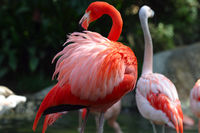
Flamingos ( genus Phoenicopterus monotypic in family Phoenicopteridae) are gregarious wading birds, usually 3–5 feet in height, found in both the Western and Eastern Hemispheres. They are more numerous in the latter, but there are four species in the Americas against two in the Old World. Flamingos live in large flocks in aquatic areas.
 Jump to Page Contents Jump to Page Contents
|
|

Pay as you go
No monthly charges. Access for the price of a phone call
Go>
Unmetered
Flat rate dialup access from only £4.99 a month Go>
Broadband
Surf faster from just £13.99 a month Go> |
Save Even More
Combine your phone and internet, and save on your phone calls
More Info> |
This weeks hot offer
 24: Series 5
In association with Amazon.co.uk £26.97 |
|
Contents
Physiology
Classification
Extinct species
Gallery
Physiology - Contents
The larger species breed and feed in saline or brackish habitats. Nests are made of compacted mud and are in the form of a mound with a concave top, into which the single white egg is laid.
Diet
Flamingos filter-feed on shellfish and algae. Their oddly-shaped beaks are specially adapted to separate mud and silt from the food they consume, and are uniquely used upside-down. The filtering of food items is assisted by hairy structures called lamellae which line the mandibles, and the large rough-surfaced tongue. Flamingos are also noted for balancing themselves on one leg while standing and feeding.
Color
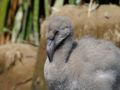
The young hatch with white plumage, but the feathers of a flamingo in adulthood range from light pink to bright red, due to carotenoids obtained from their food supply. A flamingo that is well fed and healthy is vibrantly coloured. The pinker a flamingo is, the more desirable it is as a mate. A white or pale flamingo, however, is usually unhealthy or suffering from a lack of food. Notable exceptions are the flamingos in captivity, many of which turned a pale pink as they are not fed foods containing sufficent amounts of carotene. This is changing as more zoos begin to add shrimp and other suppliments to the diets of their flamingos. All flamingos have 12 black flight feathers in each wing.
Feeding
Flamingos produce a “milk” like pigeon milk due to the action of a hormone called prolactin (see Columbidae). It contains more fat and less protein than the latter does, and it is produced in glands lining the whole of the upper digestive tract, not just the crop. Both parents nurse their chick, and young flamingos feed on this milk, which also contains red and white blood cells, for about two months until their bills are developed enough to filter feed.
One-legged Pose
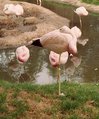
Flamingos are known to stand on one leg whilst sleeping. This is in order to not let body heat escape into the water in which their feet are submerged.
Classification - Contents
Flamingos are related to other large wading birds as follows:
- Order Ciconiiformes
- Family Cochlearidae, (Boatbill)
- Family Balaenicipitidae, (Shoebill)
- Family Scopidae, (Hammerkop)
- Family Ciconiidae, (storks)
- Family Threskiornithidae, ( ibises and spoonbills)
- Family Phoenicopteridae (sometimes classed as an order Phoenicopteriformes.)
-
Greater Flamingo (Phoenicopterus roseus), Africa, southern Asia and southern Europe.
-
Lesser Flamingo (Phoenicopterus minor), mainly in southern Africa, but the most numerous species.
-
James's Flamingo (Phoenicopterus jamesi) northern Andes
-
Andean Flamingo (Phoenicopterus andinus), southern Andes
-
Chilean Flamingo (Phoenicopterus chilensis), most widespread South American flamingo.
-
Caribbean Flamingo (Phoenicopterus ruber), until recently considered a subspecies of greater Flamingo. It breeds in the Caribbean and once inhabited Florida,
- Family Ardeidae, (herons, egrets, and bitterns)
Extinct species - Contents
Flamingos were native to Australia 20 million years ago.
Gallery - Contents
|
Change Text Size:
[A]
[default]
[A] |



 |
|
|
|
|