 |
|
|
|
Mon, 14 Sep, 2026
|

|

|
| Gold(III) chloride |
 |
| General |
|
Systematic name |
Gold(III) chloride |
| Other names |
Auric chloride
Gold trichloride |
|
Molecular formula |
AuCl3
(exists as Au2Cl6) |
|
Molar mass |
303.33 g/mol (anhydrous) |
| Appearance |
Red crystalline solid |
|
CAS number |
[13453-07-1] |
| Properties |
|
Density and phase |
3.9 g/cm3 (solid) |
|
Solubility in water |
68 g/100 ml (cold) |
| ethanol, diethyl ether |
soluble |
|
Melting point |
254 °C (527 K)
(decomposes) |
| Structure |
|
Coordination geometry |
Square planar |
|
Crystal structure |
? |
| Hazards |
|
MSDS |
External MSDS |
| Main hazards |
irritant |
|
NFPA 704 |
   Estimated Estimated |
|
R/S statement |
R: 36/37/38 S: 26-36 |
|
RTECS number |
MD5420000 (anhydrous) |
|
Supplementary data page |
|
Structure & properties |
n, εr, etc. |
|
Thermodynamic data |
Phase behaviour
Solid, liquid, gas |
|
Spectral data |
UV, IR, NMR, MS |
| Related compounds |
| Other anions |
Gold(III) fluoride
Gold(III) bromide |
| Other cations |
Gold(I) chloride
Silver(I) chloride
Platinum(II) chloride
Mercury(II) chloride |
Except where noted otherwise, data are given for
materials in their standard state (at 25°C, 100 kPa)
Infobox disclaimer and references |
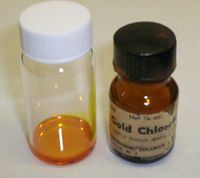
Gold(III) chloride, traditionally called auric chloride, is one of the most common compounds of gold. It has the formula AuCl3. The Roman numerals in the name indicate that the gold has an oxidation state of +3, which is the most stable form for gold in its compounds. Gold also forms another chloride, gold(I) chloride (AuCl) which is less stable than AuCl3. Also chlorauric acid (HAuCl4), the product formed when gold dissolves in aqua regia, is sometimes referred to rather loosely as "gold chloride", "acid gold trichloride" or even "gold(III) chloride trihydrate".Gold(III) chloride is very hygroscopic and highly soluble in water and ethanol. It decomposes above 160 °C or in light, and it readily forms complexes with ligands.
 Jump to Page Contents Jump to Page Contents
|
|

Pay as you go
No monthly charges. Access for the price of a phone call
Go>
Unmetered
Flat rate dialup access from only £4.99 a month Go>
Broadband
Surf faster from just £13.99 a month Go> |
Save Even More
Combine your phone and internet, and save on your phone calls
More Info> |
This weeks hot offer
 24: Series 5
In association with Amazon.co.uk £26.97 |
|
Contents
Structure
Chemical properties
Preparation
Uses
Precautions
Suppliers/Manufacturers
Structure - Contents
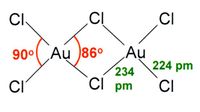 AuCl3 exists as a dimer both as a solid and as a vapour; the bromide AuBr3 follows the same pattern. This is similar (but not identical) to the tetrahedral dimers formed by AlCl3 and FeCl3. The bonding in AuCl3 is mainly covalent, reflecting the high oxidation state and relatively high electronegativity (for a metal) of the gold. AuCl3 exists as a dimer both as a solid and as a vapour; the bromide AuBr3 follows the same pattern. This is similar (but not identical) to the tetrahedral dimers formed by AlCl3 and FeCl3. The bonding in AuCl3 is mainly covalent, reflecting the high oxidation state and relatively high electronegativity (for a metal) of the gold.
Chemical properties - Contents
Anhydrous AuCl3 begins to decompose to AuCl at around 160 °C; however, this will in turn undergo disproportionation at higher temperatures to give gold metal and AuCl3.AuCl3 → AuCl + Cl2 (>160 °C)3 AuCl → AuCl3 + 2 Au (>420 °C)AuCl3 is a Lewis acid which readily forms complexes. For example with hydrochloric acid, chlorauric acid (HAuCl4) is formed:
HCl( aq) + AuCl3(aq) → H+AuCl4−(aq)Ionic chlorides such as KCl will also form the AuCl4− ion with AuCl3.Aqueous solutions of AuCl3 react with alkalis such as sodium hydroxide to form a precipitate of impure Au(OH)3, which will dissolve in excess NaOH to form sodium aurate (NaAuO2). If gently heated, Au(OH)3 decomposes to gold(III) oxide (Au2O3) and then to gold metal.
Preparation - Contents
Gold(III) chloride is most often prepared by direct chlorination of the metal at high temperatures:2 Au + 3 Cl2 → 2 AuCl3
Uses - Contents
Gold(III) chloride is one of the most common gold compounds and it is therefore used as the starting point for the synthesis of many other gold compounds, for example the water-soluble cyanide complex KAu(CN)4:AuCl3 + 4 KCN → KAu(CN)4 + 3 KClGold(III) salts, especially NaAuCl4 (made from AuCl3 + NaCl), provide a non-toxic alternative to mercury(II) salts as catalysts for alkyne reactions. One important reaction of this sort is the hydration of terminal alkynes to produce methyl ketones, for example[7]:
 Ketones are generally formed in over 90% yield under these conditions. Also useful is the related amination of alkynes which can use gold(III) catalysis.In recent years AuCl3 has begun to attract the interest of organic chemists as a mild acid catalyst for other reactions such as alkylation of aromatics and a conversion of furans to phenols (see below). Such reactions find use in organic synthesis and in the pharmaceutical industry. For example, 2-methylfuran (sylvan) undergoes smooth alkylation by methyl vinyl ketone at the 5-position: Ketones are generally formed in over 90% yield under these conditions. Also useful is the related amination of alkynes which can use gold(III) catalysis.In recent years AuCl3 has begun to attract the interest of organic chemists as a mild acid catalyst for other reactions such as alkylation of aromatics and a conversion of furans to phenols (see below). Such reactions find use in organic synthesis and in the pharmaceutical industry. For example, 2-methylfuran (sylvan) undergoes smooth alkylation by methyl vinyl ketone at the 5-position:
 The reaction gives a 91% yield in only 40 minutes at room temperature, using only 1 mole% of AuCl3 in acetonitrile. This yield is noteworthy since both the furan and the ketone are normally very sensitive to side-reactions such as polymerisation under acidic conditions. In some cases where alkynes are present, a phenol may be formed[8]: The reaction gives a 91% yield in only 40 minutes at room temperature, using only 1 mole% of AuCl3 in acetonitrile. This yield is noteworthy since both the furan and the ketone are normally very sensitive to side-reactions such as polymerisation under acidic conditions. In some cases where alkynes are present, a phenol may be formed[8]:
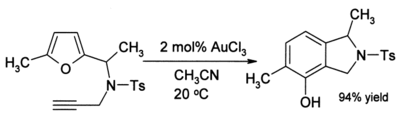 The reaction probably begins with a Diels-Alder reaction between the furan ring and the alkyne, followed by a complex rearrangement that leads to formation of the new aromatic ring. The reaction probably begins with a Diels-Alder reaction between the furan ring and the alkyne, followed by a complex rearrangement that leads to formation of the new aromatic ring.
Precautions - Contents
Gold(III) chloride should be handled wearing gloves and goggles, and direct contact with the material should be avoided.
Suppliers/Manufacturers - Contents
-
Alfa
-
Sigma-Aldrich
-
Strem
-
Fisher
-
VWR
|
Change Text Size:
[A]
[default]
[A] |



 |
|
|
|
|

