 |
|
|
|
Thu, 01 Oct, 2026
|

|

|
|
? Great Hammerhead |
|
| Scientific classification |
| Kingdom: |
Animalia
|
| Phylum: |
Chordata
|
| Class: |
Chondrichthyes
|
| Order: |
Carcharhiniformes
|
| Family: |
Sphyrnidae
|
| Genus: |
Sphyrna
|
| Species: |
S. mokarran
|
|
|
|
|
|
|
|
Sphyrna mokarran
( Rüppell, 1837) |
|
|
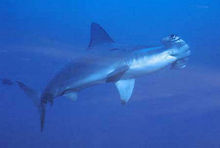
The great hammerhead shark, Sphyrna mokarran, is the largest species of hammerhead sharks.
 Jump to Page Contents Jump to Page Contents
|
|

Pay as you go
No monthly charges. Access for the price of a phone call
Go>
Unmetered
Flat rate dialup access from only £4.99 a month Go>
Broadband
Surf faster from just £13.99 a month Go> |
Save Even More
Combine your phone and internet, and save on your phone calls
More Info> |
This weeks hot offer
 24: Series 5
In association with Amazon.co.uk £26.97 |
|
Contents
Distribution
Anatomy and appearance
Diet
Behavior
Reproduction
Distribution - Contents
The great hammerhead shark is found worldwide in coastal areas and above continental shelves in warm and tropical waters to depths of 80m (260 ft).
Anatomy and appearance - Contents
It is easy to confuse this shark with the smooth hammerhead, since both are very large hammerhead sharks. the great hammerhead shark has a thick head in which the eyes are located at the margins.The shark has a dark brown to light grey dorsal surface, this colour can be olive as it fades into the underside of the sharks which is a lighter off-white colour.On average the great hammerhead can weigh around 500 pounds (230 kg), and the The largest reported length is 6.1m, but normal size is about 4m.Expected life span of this species is approximately 20-30 years of age.
Diet - Contents
Great hammerhead sharks eat small sharks, rays and sting rays, squid and bony fish. The great hammerhead has a defense against the venom of sting rays, which seem to be a particular favorite in their diet. They will kill sting ray by using their hammer shaped head to pin them down while they bite the wings of the ray. They hunt alone.
Behavior - Contents
When encountered by divers, the great hammerhead is usually quite shy and normally not aggressive towards divers. However, it is considered one of the more dangerous sharks.
Reproduction - Contents
Great hammerheads are viviparous. They give birth to a litter of between 6–42 young. The gestation period is 11 months. Size at birth is about .60–.70m. Females mature at about 2.10–2.50m and males at about 2.25–2.70m. |
Change Text Size:
[A]
[default]
[A] |



 |
|
|
|
|

