 |
|
|
|
Mon, 14 Sep, 2026
|

|
|

Pay as you go
No monthly charges. Access for the price of a phone call
Go>
Unmetered
Flat rate dialup access from only £4.99 a month Go>
Broadband
Surf faster from just £13.99 a month Go> |
Save Even More
Combine your phone and internet, and save on your phone calls
More Info> |
This weeks hot offer
 24: Series 5
In association with Amazon.co.uk £26.97 |
|
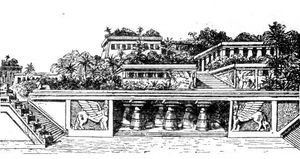 Gardens of Semiramis, 20th century interpretation
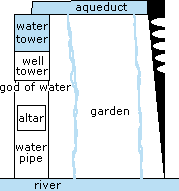
The Hanging Gardens of Babylon (also known as the Hanging Gardens of Semiramis) and the walls of Babylon (present-day Iraq) were considered one of the Seven Wonders of the World. They were both supposedly built by Nebuchadnezzar II around 600 BC .The Hanging Gardens are extensively documented by Greek historians such as Strabo and Diodorus Siculus, but otherwise there is little evidence for their existence. Some (circumstantial) evidence gathered at the excavation of the palace at Babylon has been accrued, but does not completely substantiate what look like fanciful descriptions.Some schools of thought think that through the ages the location may have been confused with gardens that existed at Nineveh as tablets from there clearly showing gardens have been found. Writings on these tablets describe the possible use of something similar to an Archimedes' screw as a process of raising the water to the required height.
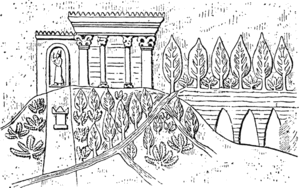 Hanging Garden, Assyrian interpretation
|
 |
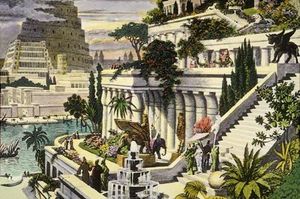 A 16th century depiction of the Hanging Gardens of Babylon (by Martin Heemskerck). You can see the Tower of babel in the background.
According to accounts, the gardens were built to cheer up Nebuchadnezzar's homesick wife, Amyitis. Amyitis, daughter of the king of the Medes, was married to Nebuchadnezzar to create an alliance between the nations. The land she came from, though, was green, rugged and mountainous, and she found the flat, sun-baked terrain of the Mesopotamia (a region of southwest Asia) depressing. The king decided to recreate her homeland by building an artificial mountain with rooftop gardens.The Hanging Gardens probably did not really "hang" in the sense of being suspended from cables or ropes. The name comes from an inexact translation of the Greek word kremastos or the Latin word pensilis, which means not just "hanging” but "overhanging," as in the case of a terrace or balcony.The Greek geographer Strabo, who described the gardens in the first century BC, wrote, "It consists of vaulted terraces raised one above another, and resting upon cube-shaped pillars. These are hollow and filled with earth to allow trees of the largest size to be planted. The pillars, vaults, and terraces are constructed of baked brick and asphalt."If the gardens did exist they would have presented an amazing spectacle: A green, leafy, artificial mountain rising off the plain. |
Change Text Size:
[A]
[default]
[A] |



 |
|
|
|
|


