 |
|
|
|
Tue, 15 Sep, 2026
|

|

|
|
? Hermit crab |
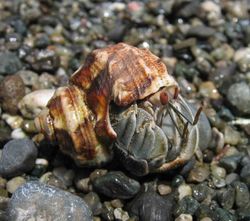
A Hermit Crab in Corcovado National Park in Costa Rica
|
| Scientific classification |
| Kingdom: |
Animalia
|
| Phylum: |
Arthropoda
|
| Subphylum: |
Crustacea
|
| Class: |
Malacostraca
|
| Order: |
Decapoda
|
| Suborder: |
Pleocyemata
|
| Infraorder: |
Anomura
|
| Superfamily: |
Paguroidea
Latreille, 1802 |
|
|
|
|
|
|
Families
|
-
Coenobitidae
-
Diogenidae
-
Lithodidae
-
Paguridae
-
Parapaguridae
-
Pylochelidae
|
Hermit crabs are decapod crustaceans of the superfamily Paguroidea, distinct from the true crabs in the infra-order Brachyura. Most hermit crabs salvage empty seashells to shelter and protect their soft abdomens. There are about five hundred known species of hermit crabs in the world; although they are mostly aquatic, there are also some terrestrial species. A number of species, most notably king crabs, have abandoned seashells for a free-living life; these species have forms similar to true crabs and are known as carcinized hermit crabs.
 Jump to Page Contents Jump to Page Contents
|
|

Pay as you go
No monthly charges. Access for the price of a phone call
Go>
Unmetered
Flat rate dialup access from only £4.99 a month Go>
Broadband
Surf faster from just £13.99 a month Go> |
Save Even More
Combine your phone and internet, and save on your phone calls
More Info> |
This weeks hot offer
 24: Series 5
In association with Amazon.co.uk £26.97 |
|
Contents
Commonly kept marine hermit crabs
Lifespan
Commonly kept marine hermit crabs - Contents
There are several species of hermit crabs that are common in the marine aquarium trade. These omnivorous or herbivorous species are useful in the household aquarium as scavengers, eating algae and other debris.The scarlet hermit crab, or Red Reef hermit crab (Paguristes cadenati), is a handsome and interesting species with a bright red body and yellow eyestalks, and stays rather small (about 2-5 cm / 1-2 inches across). Smaller species of a similar passive nature include the zebra hermit crab (brown legs with white bands), the red-tip crab and blue-legged crab.The species most commonly kept as pets in the United States are the Caribbean hermit crab (Coenobita clypeatus) and the Pacific hermit crab (Coenobita compressus). In Europe, the common hermit crab (Pagurus bernhardus) is popular.
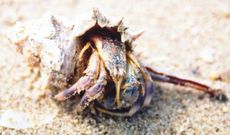 A hermit crab from the Gulf of Thailand
While most species available in pet stores are small like those listed above, and are simply scavengers, others may grow quite large (some on the Pacific coast can grow to 30 cm / 12 inches) and may eat coral, clams and other crustaceans. So be sure to ask if the species is not clearly marked.Most hermit crabs will appreciate a salinity of between 1.023 and 1.025, and temperatures between 4 to 14 °C (temperate species) to 24 to 27 °C (tropical species), with a good bed, algae to graze on and a variety of shells to change into. They will happily switch shells frequently if given the opportunity - an interesting display to watch.
Lifespan - Contents
Hermit crab lifespans can vary greatly. In captivity, they usually live for about two to five years, but proper care can add an extra twenty or thirty years to their lives. There have been hermit crabs documented living over seventy years old, but these are most likely exceptional cases. |
Change Text Size:
[A]
[default]
[A] |



 |
|
|
|
|

