|
|
|
|
Mon, 14 Sep, 2026
|

|
|

Pay as you go
No monthly charges. Access for the price of a phone call
Go>
Unmetered
Flat rate dialup access from only £4.99 a month Go>
Broadband
Surf faster from just £13.99 a month Go> |
Save Even More
Combine your phone and internet, and save on your phone calls
More Info> |
This weeks hot offer
 24: Series 5
In association with Amazon.co.uk £26.97 |
|
|
? Impala
Conservation status: Lower risk
|

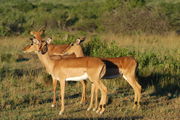
An Impala in Etosha National Park, Namibia
|
| Scientific classification |
| Kingdom: |
Animalia
|
| Phylum: |
Chordata
|
| Class: |
Mammalia
|
| Order: |
Artiodactyla
|
| Family: |
Bovidae
|
| Subfamily: |
Aepycerotinae
Gray, 1872 |
| Genus: |
Aepyceros
Sundevall, 1847 |
| Species: |
A. melampus
|
|
|
|
|
|
|
|
Aepyceros melampus
( Lichtenstein, 1812) |
|
|
An impala (Aepyceros melampus Greek aipos "high" ceros "horn" + melas "black" pous "foot") is a medium-sized African antelope. The name impala comes from the Zulu language. Impalas weigh about 50 kg, are reddish-brown in colour with lighter flanks, and have white underbellies. The male has lyre-shaped horns. Impala are among the most beautiful and graceful of the antelopes. They can normally be found foraging around the Butagee of South Africa. They are among the dominant species in many savannas.Exceedingly agile, impala are capable of leaping over 10 m in a single bound. They are gregarious creatures and are usually found in herds, often a male with many females. They are common throughout Southern Africa. Their food consists of a mixture of grasses and woody species.Many species of predators eat impala. This fact, and the distinctive M shape on the backside gave the impala its nickname as "the McDonald's of the African plains".
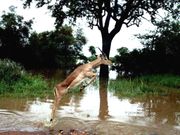 Impala leaping from the water
|
Change Text Size:
[A]
[default]
[A] |



 |
|
|
|
|