|
|
|
|
Mon, 14 Sep, 2026
|

|

|
|
? Macaws |
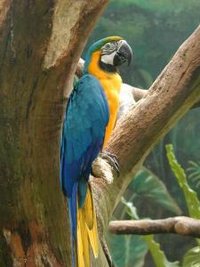
Blue-and-yellow Macaw
|
| Scientific classification |
|
|
|
|
|
Genera
|
Ara
Anodorhynchus
Cyanopsitta
Propyrrhura
Orthopsittaca
Diopsittaca
|
Macaws are large colorful New World parrots, classified into six of the many Psittacidae genera: Ara, Anodorhynchus, Cyanopsitta, Propyrrhura, Orthopsittaca, and Diopsittaca. They are the largest birds in the parrot family in length and wingspan, though the flightless Kakapo is heavier.Parrots are zygodactyl, like woodpeckers, having 4 toes on each foot – two front and two back.Their native habitats are the forests, especially rain forests, of Mexico and Central and South America. They are locally also known as "Guacamayos" in Spanish and Arara in Portuguese.
 Jump to Page Contents Jump to Page Contents
|
|

Pay as you go
No monthly charges. Access for the price of a phone call
Go>
Unmetered
Flat rate dialup access from only £4.99 a month Go>
Broadband
Surf faster from just £13.99 a month Go> |
Save Even More
Combine your phone and internet, and save on your phone calls
More Info> |
This weeks hot offer
 24: Series 5
In association with Amazon.co.uk £26.97 |
|
Contents
Status
Birds in captivity
Gallery
Species list
Status - Contents
The majority of macaws are now endangered in the wild. Five species of macaw are already extinct, and Spix's Macaw is now considered to be extinct in the wild. The Glaucous Macaw is also probably extinct, with only two reliable records of sightings in the 20th century. The greatest problems threatening the macaw population are the rapid rate of deforestation and the illegal trapping of birds for the bird trade.
Birds in captivity - Contents
Macaws eat nuts and fruit and are gnaw and chew on various objects. They show a lot of intelligence in their behaviours.Bonding: Macaws have been said to live for upto 100 years; however, an average of 50 years is probably more accurate. The larger macaws may live up to 65 years. A Macaw as a pet will therefore likely be a companion for life, and many outlive their human keepers. They are monogamous and mate for life. In captivity unmated macaws will bond primarily with one person – their keeper. Pet macaws thrive on frequent interaction, handling and love just as humans do. Lack of this can lead to their mental and physical suffering.Other sub-bondings also take place and most macaws that are subjected to non-aggressive behaviour will trust most humans and can be handled even by strangers if someone familiar is also alongside.Without proper adult supervision, macaws are unsuitable as pets for children. All species of macaws have very powerful, large beaks and are capable of causing a considerable amount of harm to both children and adults. They are delicate creatures and require respectful, and loving husbandry from handlers. Macaws tend to be extremely loud: their voices are designed to carry over long distances. This makes Macaws very demanding birds to keep and are best avoided as household pets.
Gallery - Contents
Blue and Gold Macaws (Ara ararauna)
|
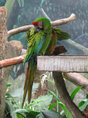
Military Macaw (Ara militaris)
|
Species list - Contents
- Anodorhynchus
- Anodorhynchus glaucus : Glaucous Macaw Conservation status: Critical
- Anodorhynchus hyacinthinus : Hyacinth Macaw Conservation status: Endangered
- Anodorhynchus leari : Indigo Macaw or Lear's Macaw Conservation status: Critical
- Cyanopsitta
- Cyanopsitta spixii : Little Blue Macaw or Spix's Macaw Conservation status: Critical
- Ara
- Ara ararauna : Blue-and-yellow Macaw
- Ara glaucogularis : Blue-throated Macaw Conservation status: Critical
- Ara militaris : Military Macaw Conservation status: Vulnerable
- Ara ambigua : Buffon's Macaw or Great Green Macaw Conservation status: Vulnerable
- Ara macao : Scarlet Macaw or Aracanga
- Ara chloroptera : Greenwing Macaw or Red-and-green Macaw
- Ara rubrogenys : Red-fronted Macaw Conservation status: Endangered
- Ara severa : Chestnut-fronted Macaw
- Ara atwoodi : Dominican Green-and-Yellow Macaw Conservation status: Extinct ( 1791)
- Ara erythrocephala : Jamaican Green-and-Yellow Macaw Conservation status: Extinct (early 1800s)
- Ara gossei : Jamaican Red Macaw Conservation status: Extinct (late 1700s)
- Ara guadeloupensis : Lesser Antillean Macaw Conservation status: Extinct ( 1760)
- Ara tricolor : Cuban Macaw Conservation status: Extinct ( 1885)
- Orthopsittaca
- Orthopsittaca manilata : Red-bellied Macaw
- Propyrrhura
- Propyrrhura couloni : Blue-headed Macaw
- Propyrrhura maracana : Illiger's Macaw or Blue-winged Macaw Conservation status: Vulnerable
- Propyrrhura auricollis : Golden-collared Macaw
- Diopsittaca
- Diopsittaca nobilis : Red-shouldered Macaw or Hahn's Macaw
|
Change Text Size:
[A]
[default]
[A] |



 |
|
|
|
|