 |
|
|
|
Sun, 26 Jul, 2026
|

|
|

Pay as you go
No monthly charges. Access for the price of a phone call
Go>
Unmetered
Flat rate dialup access from only £4.99 a month Go>
Broadband
Surf faster from just £13.99 a month Go> |
Save Even More
Combine your phone and internet, and save on your phone calls
More Info> |
This weeks hot offer
 24: Series 5
In association with Amazon.co.uk £26.97 |
|
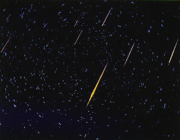 Leonid Meteor Shower
From earliest times, humankind has noticed flurries of meteors that seemed to emanate from particular points in the sky at particular times of the year. These flurries, now called meteor showers, are produced by small fragments of cosmic debris entering the earth's atmosphere at extremely high speed. When the number of meteors is large, it is called a meteor storm. Each time a periodic comet swings by the Sun, it produces large amounts of small particles which will eventually spread out along the entire orbit of the comet to form a meteoroid "stream". If the Earth's orbit and the comet's orbit intersect at some point, then the Earth will pass through this stream for a few days at roughly the same time each year, producing a meteor shower. The parent bodies (comets) of most known meteor showers have now been identified.Most meteors seen in meteor showers are caused by particles smaller than a grain of sand. As a result it is very rare to have any meteorites hit the ground during a typical meteor shower.Because meteor shower particles are all traveling in parallel paths, and at the same velocity, they will all appear to radiate from a single point in the sky to an observer below. This radiant point is caused by the effect of perspective, similar to railroad tracks converging at a single vanishing point on the horizon when viewed from the middle of the tracks.Any other solar system body with a reasonably transparent atmosphere can also have meteor showers. For instance, Mars is known to have meteor showers, although these will be different than the ones seen on Earth because the different orbits of Mars and Earth will intersect with orbits of comets in different ways. On March 7, 2004, the panoramic camera on Mars Exploration Rover Spirit recorded a streak which is now believed to have been caused by a meteor from a Martian meteor shower associated with comet 114P/Wiseman-Skiff. A strong display from this shower is expected on December 20, 2007, although it is unlikely that Spirit or Opportunity will still be operational at that time to observe it. |
Change Text Size:
[A]
[default]
[A] |



 |
|
|
|
|


