 |
|
|
|
Thu, 01 Oct, 2026
|

|
|

Pay as you go
No monthly charges. Access for the price of a phone call
Go>
Unmetered
Flat rate dialup access from only £4.99 a month Go>
Broadband
Surf faster from just £13.99 a month Go> |
Save Even More
Combine your phone and internet, and save on your phone calls
More Info> |
This weeks hot offer
 24: Series 5
In association with Amazon.co.uk £26.97 |
|
|
? Milk Thistle |
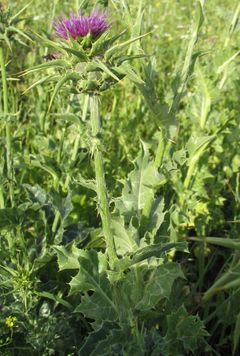
Silybum marianum
|
| Scientific classification |
| Kingdom: |
Plantae
|
| Division: |
Magnoliophyta
|
| Class: |
Magnoliopsida
|
| Order: |
Asterales
|
| Family: |
Asteraceae
|
| Subfamily: |
Lactucoideae
|
| Tribe: |
Cardueae
|
| Genus: |
Silybum
Adans. |
|
|
|
|
|
|
Species
|
- Silybum eburneum
- Silybum marianum
- Silybum × gonzaloi
|
The Milk thistles are plants of the genus Silybum Adans., flowering plants of the daisy family (Asteraceae).They are native to the Mediterranean regions of Europe, North Africa and the Middle East, and are traditionally considered to be the national flower of Scotland.
 Thistle Flower
Members of this genus grow as annual or biennial plants. The erect stem is tall, branched and furrowed but not spiny. The large, alternate leaves are waxy-lobed, toothed and thorny, as in other genera of thistle. The lower leaves are cauline (= attached to the stem without petiole). The upper leaves have a clasping base. They have large, disc-shaped pink-to-purple, rarely white, solitary flower heads at the end of the stem. The flowers consist of tubular florets. The phyllaries under the flowers occur in many rows, with the outer row with spine-tipped lobes and apical spines. The fruit is a black achene with a white pappus.Only two species are currently classified in this genus:
- Silybum eburneum Coss. & Dur., known as the Silver Milk Thistle, Elephant Thistle, or Ivory Thistle
- Silybum eburneum Coss. & Dur. var. hispanicum
- Silybum marianum ( L.) Gaertner, the Blessed Milk Thistle, which has a large number of other common names, such as Variegated Thistle.
The two species hybridise naturally, the hybrid being known as Silybum × gonzaloi Cantó , Sánchez Mata & Rivas Mart. (S. eburneum var. hispanicum x S. marianum)A number of other plants have been classified in this genus in the past but have since been relocated elsewhere in the light of additional research.By far the more widely known species is S. marianum, which is known to give some remedy for liver diseases : cirrhosis, jaundice and hepatitis. Its potent extract is used in medicine under the name silymarin. Another extract, silibinin or a derivative, is used against poisoning by amanitas, such as the Death Cap (Amanita phalloides) and the Fly Agaric (Amanita muscaria).It has been widely introduced outside its natural range, for example into North America, where it is considered an invasive weed, and New Zealand. |
Change Text Size:
[A]
[default]
[A] |



 |
|
|
|
|


