 |
|
|
|
Tue, 15 Sep, 2026
|

|
|

Pay as you go
No monthly charges. Access for the price of a phone call
Go>
Unmetered
Flat rate dialup access from only £4.99 a month Go>
Broadband
Surf faster from just £13.99 a month Go> |
Save Even More
Combine your phone and internet, and save on your phone calls
More Info> |
This weeks hot offer
 24: Series 5
In association with Amazon.co.uk £26.97 |
|
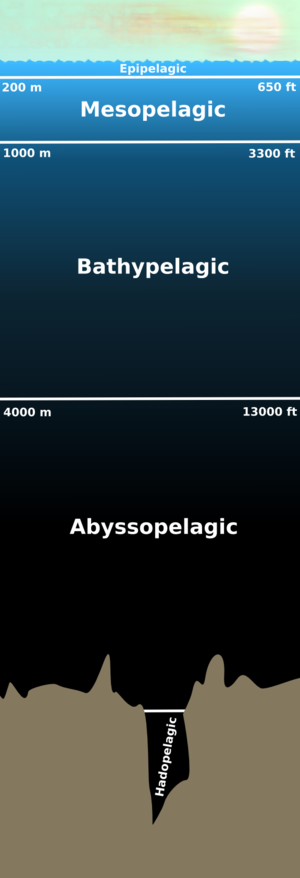 Diagram of the layers of the pelagic zone.
The pelagic zone is the part of the open sea or ocean comprising the water column, i.e. all of the sea other than that near the coast or the sea floor. In contrast, the demersal zone comprises the water that is near to (and thus is significantly affected by) the coast or the sea floor. The name is derived from the Greek πέλαγος (pélagos), which is roughly translated as "sea" but is more accurately translated as "open sea."The pelagic zone is further divided into a number of sub-zones, based on their different ecological characteristics (which is roughly a function of depth):
- Epipelagic (from the surface down to around 200 m) - the illuminated surface zone where there is enough light for photosynthesis, and thus plants and animals are largely concentrated in this zone. Here one will typically encounter fish such as tuna and many sharks.
- Mesopelagic (from 200 m down to around 1000 m) - the twilight zone. Although some light penetrates this deep, it is insufficient for photosynthesis. The name stems from Greek μέσον, middle.
- Bathypelagic (from 1000 m down to around 4000 m) - by this depth the ocean is almost entirely dark (with only the occasional bioluminescent organism). There are no living plants, and most animals survive by consuming the snow of detritus falling from the zones above, or (like the marine hatchetfish) by preying upon others. Giant squid live at this depth, and here they are hunted by deep-diving sperm whales. From Greek βάθος (bathos), depth, and βαθύς (bathys), deep.
- Abyssopelagic (from 4000 m down to above the ocean floor) - no light whatsoever penetrates to this depth, and most creatures are blind and colourless. The name is derived from the greek άβυσσος (ábyssos), abyss, meaning bottomless (a holdover from the times when the deep ocean was believed to be bottomless).
- Hadopelagic (the deep water in ocean trenches) - the name is derived from Hades, the classical greek underworld. This zone is 90% unknown and very few species are known to live here.
The epipelagic and (arguably) the mesopelagic zones together comprise the open ocean's photic zone. The remaining (lower) zones comprise the open ocean's aphotic zone.The bathypelagic, abyssopelagic, and hadopelagic zones are very similar in character, and some marine biologists elide them into a single zone or consider the latter two to be the same. Some define the hadopelagic as waters below 6000 meters, whether in a trench or not. |
Change Text Size:
[A]
[default]
[A] |



 |
|
|
|
|


