 |
|
|
|
Wed, 16 Sep, 2026
|

|

|
| Phosphorus trichloride |
Phosphorus trichloride |
| General |
|
Systematic name |
Phosphorus trichloride |
| Other names |
Phosphorus(III) chloride
Phosphorous chloride |
|
Molecular formula |
PCl3 |
|
Molar mass |
137.33 g/mol |
| Appearance |
clear, colourless liquid |
|
CAS number |
[7719-12-2] |
|
EINECS number |
231-749-3 |
|
MSDS |
External MSDS |
| Bulk properties |
|
Density |
1.574 g/cm3 |
|
Solubility |
Water: rapid hydrolysis
Methanol: decomposesBenzene: soluble
Chloroform: soluble
Diethyl ether: soluble |
|
Melting point |
-93.6 °C (179.6 K) |
|
Boiling point |
76.1 °C (349.3 K) |
Standard enthalpy
of formation ΔfH0liq
|
−319.7 kJ/ mol (liquid) |
| Hazards |
Corrosive, toxic, reducing agent,reacts with water & alcohols |
| Structure |
|
Molecular geometry |
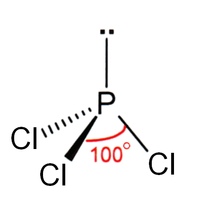
Trigonal pyramidal |
|
Bond angle |
100 ° |
|
Bond length |
P-Cl 204 pm (2.04 Å) |
|
Dipole moment |
0.56 D |
| Related compounds |
| Other trichlorides |
Nitrogen trichloride
Arsenic trichloride
Antimony trichloride |
| Related phosphorus compounds |
Phosphorus pentachloride
Phosphorus oxychloride
Diphosphorus tetrachloride |
| Other halogens |
Phosphorus trifluoride Phosphorus tribromide
Phosphorus triiodide |
Phosphorus trichloride (formula PCl3) is the most important of the three phosphorus chlorides. It is a toxic corrosive liquid (at room temperature and pressure) which reacts violently with water. It is an important industrial chemical, being used for the manufacture of organophosphorus compounds for herbicides, insecticides and plasticisers, as well as for making oil additives and flame retardants. It is a reducing agent, being readily oxidised to phosphorus pentachloride or phosphorus oxychloride.
 Jump to Page Contents Jump to Page Contents
|
|

Pay as you go
No monthly charges. Access for the price of a phone call
Go>
Unmetered
Flat rate dialup access from only £4.99 a month Go>
Broadband
Surf faster from just £13.99 a month Go> |
Save Even More
Combine your phone and internet, and save on your phone calls
More Info> |
This weeks hot offer
 24: Series 5
In association with Amazon.co.uk £26.97 |
|
Contents
Physical properties
Chemical properties
Preparation
Uses
Precautions
Suppliers/Manufacturers
Physical properties - Contents
Phosphorus trichloride has a dipole moment of 0.8 D in CCl4 and a bond angle of 100.27°. Liquid PCl3 has a standard enthalpy of formation of -319.7 kJ/ mol. The phosphorus atom has an NMR chemical shift of 220 ppm (downfield of H3PO4).
Chemical properties - Contents
In phosphorus trichloride (PCl3), the phosphorus is in the +3 oxidation state and the chlorines are in the -1 oxidation state. PCl3 reacts rapidly and exothermically with water to form phosphorous acid, H3PO3 and HCl. A large number of similar substitution reactions are known, the most important of which is the formation of phosphite esters by reaction with alcohols or phenols. For example, with phenol, triphenyl phosphite is formed:
- 3 PhOH + PCl3 → P(OPh)3 + 3 HCl
where "Ph" stands for phenyl group, -C6H5. Alcohols such as ethanol react similarly in the presence of a base such as triethylamine to give phosphite esters such as triethyl phosphite ( ethyl group is -C2H5):
- 3 C2H5OH + PCl3 → P(OC2H5)3 + 3 HCl
However without base, the reaction leads to the formation of a dialkyl phosphonate and an alkyl chloride, for example:
- PCl3 + 3 C2H5OH → (C2H5O)2P(=O)H + C2H5Cl + 2 HCl
where ethyl is the alkyl group. Under certain conditions the reaction may lead to only the alkyl chloride and phosphorous acid.
Amines such as R2NH form P(NR2)3, and thiols (RSH) form P(SR)3. An industrially relevant reaction of PCl3 with amines is phosphonomethylation, using an amine such as R2NH, PCl3 and formaldehyde or paraformaldehyde to form an aminophosphonate (OH)2P(O) - CH2 - NR2. Aminophosphonates are widely used as sequestring and antiscale agents in water treatment. The large volume herbicide glyphosate is also produced this way. The substitution reaction of PCl3 with Grignard reagents and organolithium reagents provides a useful method for the preparation of organic phosphines R3P (sometimes called phosphanes) such as triphenylphosphine, Ph3P.
- 3 PhMgBr + PCl3 → Ph3P + 3 MgBrCl
PCl3 will in fact substitute directly onto an aromatic ring, for example benzene will form PhPCl2.Phosphorus trichloride has a lone pair, and therefore can act as a Lewis base, for example with the Lewis acids BBr3[5] it forms a 1:1 adduct, Br3B−−+PCl3. Even metal complexes such as Ni(PCl3)4 are known. This Lewis basicity is evident in one useful route to organophosphorus compounds:
- PCl3 + RCl + AlCl3 → (RPCl3)+ −AlCl4
The (RPCl3)+ product can then be decomposed with water to produce an alkylphosphonic dichloride RP(=O)Cl2.
Preparation - Contents
Phosphorus trichloride is prepared industrially by the reaction of chlorine with a refluxing solution of white phosphorus in phosphorus trichloride, with continuous removal of PCl3 as it is formed. In the laboratory it may be more convenient to use the less toxic red phosphorus[6].
- P4 + 6 Cl2 → 4 PCl3
Industrial production of phosphorus trichloride is controlled under the Chemical Weapons Convention, where it is listed in schedule 3.
Uses - Contents
World production exceeds one-third of a million tonnes[1]. Phosphorus trichloride is an important starting point for the manufacture of many industrial products containing phosphorus. It is the starting material for organophosphorus compounds which contain one or more (P3+) atoms, most notably phosphites and phosphonates. These compounds do not usually contain the chlorine atoms found in (PCl3). These are lost as hydrogen chloride (HCl) during their synthesis. (PCl3) is however the usual starting compound for their synthesis, since it is the most versatile and cheapest source of P3+.An important part of the total PCl3 production is oxidised to produce PCl5, POCl3 or PSCl3. POCl3is the most important of these from an industrial viewpoint. It is used for the manufacture of organic phosphates such as triphenyl phosphate and tricresyl phosphate, which find application as flame retardants and plasticisers for PVC. They are also used to make insecticides such as diazinon. PCl3 is used on an industrial scale to make phosphonates, the herbicide glyphosate, triphenylphosphine for the Wittig reaction, and phosphite esters which may be used as industrial intermediates, or used in the Horner-Wadsworth-Emmons reaction, both important methods for making alkenes. It can be used to make trioctylphosphine oxide (TOPO), used as an extraction agent, although TOPO is usually made via the corresponding phosphine.PCl3 is also used directly as a reagent in organic synthesis. It is used to convert primary and secondary alcohols into alkyl chlorides, or carboxylic acids into acyl chlorides, although thionyl chloride generally gives better yields than PCl3[8].
Precautions - Contents
PCl3 is highly toxic, with a concentration of 600 ppm being lethal in just a few minutes[7]. It reacts violently with water and is highly corrosive. Wear gloves and goggles and work in a fume cupboard (hood), and use an apron and face shield with larger amounts. It is a reducing agent and should be kept away from strong oxidising agents.PCl3 is classified as very toxic and corrosive under EU Directive 67/548/EEC, and the risk phrases R14, R26/28, R35 and R48/20 are obligatory.
Suppliers/Manufacturers - Contents
-
Aldrich
-
Strem
-
Thermphos
-
Fisher
-
VWR
-
Alfa
|
Change Text Size:
[A]
[default]
[A] |



 |
|
|
|
|

