 |
|
|
|
Thu, 01 Oct, 2026
|

|

|
|
? Pinworm |
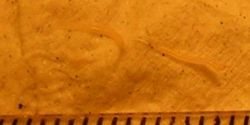
Two pinworms, captured on emergence from the anus. Markings are 1 mm apart
|
| Scientific classification |
| Kingdom: |
Animalia
|
| Phylum: |
Nematoda
|
| Class: |
Secernentea
|
| Order: |
Rhabditida
|
| Family: |
Oxyuridae
|
| Genus: |
Enterobius
|
|
|
|
|
|
|
|
The pinworm (Genus Enterobius) is a parasitic roundworm of the phylum Nematoda.
 Jump to Page Contents Jump to Page Contents
|
|

Pay as you go
No monthly charges. Access for the price of a phone call
Go>
Unmetered
Flat rate dialup access from only £4.99 a month Go>
Broadband
Surf faster from just £13.99 a month Go> |
Save Even More
Combine your phone and internet, and save on your phone calls
More Info> |
This weeks hot offer
 24: Series 5
In association with Amazon.co.uk £26.97 |
|
Contents
Forms of worm
Habitat
Reproduction
Effects
Treatment
Forms of worm - Contents
The best known is the human pinworm, also known as the threadworms Enterobius vermicularis and the more recently discovered Enterobius gregorii. The adult pinworm male is 1–4 mm in length, while the adult female is 8–13 mm and possess the long, pin-shaped posterior end for which the worm is named. The human pinworm is commonly found in children.
Habitat - Contents
The pinworm lives in the lower part of the small intestine, and the upper part of the colon. It is found worldwide and causes the common infection enterobiasis in humans. Unlike many other intestinal parasites, the pinworm does not usually enter the bloodstream or any other organs besides the intestines. Only in rare cases disoriented pinworms can be found in the vagina, and even more rarely in the uterus, fallopian tubes, liver and peritoneum; but the worms cannot survive long in these places.
Reproduction - Contents
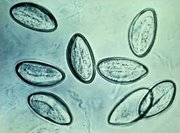 Pinworm eggs are easily seen under the microscope.
After mating the male dies. The female migrates to the anus, and emerges (usually during the night) to deposit about 10,000 to 20,000 eggs in the perianal area (around the anus). It then secretes a substance that causes a very strong itching sensation, inciting the host to scratch the area and thus transfer some of the eggs to the fingers. Once ingested orally, the larvae hatch and migrate back to the intestine, growing to maturity in 30-45 days. The eggs can survive from 2 to 3 weeks on their own outside of the human body.
Effects - Contents
Except for the itching, it does not usually cause any damage to the body. Sleep disturbance may arise from the itching or crawling sensations. Diagnosis is usually made clinically by observing the female worm (or many worms) in the peri-anal region, but can also be made using the "scotch-tape" test. Treating the entire family is often necessary for cure.
Treatment - Contents
Anti-pinworm drugs such as Albenza (albendazole) or Vermox (mebendazole) are commonly used to treat pinworms. These medicines kill the pinworms 95% of the time, but do not kill the eggs. The person being treated may have to return after a time of two weeks to be retreated. Another precaution towards treating the eradication of pinworms is to wash hands before eating (to prevent any pinworm eggs under fingernails from being ingested) and to wash any area or clothes that have touched or been in the vicinity of the infected areas.
|
Change Text Size:
[A]
[default]
[A] |



 |
|
|
|
|

