 |
|
|
|
Mon, 14 Sep, 2026
|

|
|

Pay as you go
No monthly charges. Access for the price of a phone call
Go>
Unmetered
Flat rate dialup access from only £4.99 a month Go>
Broadband
Surf faster from just £13.99 a month Go> |
Save Even More
Combine your phone and internet, and save on your phone calls
More Info> |
This weeks hot offer
 24: Series 5
In association with Amazon.co.uk £26.97 |
|
Potosí is a city, the capital of the department of Potosí in Bolivia. It is at an altitude of 3967 meters and has about 115,000 inhabitants. It is claimed to be the highest city in the world. It lies beneath the Cerro Rico ("Rich mountain"), a mountain of silver ore, which has always dominated the city.
 Potosí, aerial photo
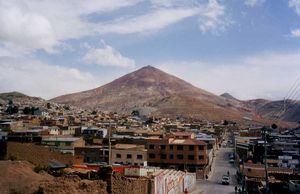 Potosí with Cerro Rico
Founded 1546 as a mining town, it soon acquired fabulous wealth, becoming the largest city in the Americas (except for Mexico City) with a population exceeding 200,000 people. In Spanish there is still a saying vale un Potosí meaning "being worth a fortune" and, for Europeans, "Peru" was a mythical land of riches. It is here that most of the Spanish silver came from and Indian labour, forced by Francisco de Toledo through the mita institution, came to die by the thousands. After 1800 the silver mines became depleted, making tin the main product. This eventually led to a slow economic decline.During the War of Independence ( 1809- 1825, see History of Bolivia) Potosi was frequently passed from the control of Royalist and Patriot forces. Major blunders by the First Argentine Auxiliary Army (under the command of Castelli) led to an increased sense that independence was needed and fostered resentment towards Argentina. During that occupation there was anarchy and martial excess, and Potosi became unfriendly to the point where it could not be defended.When the second auxiliary army arrived it was received well, and the commander, Belgrano did much to heal the past wounds inflicted by the tyrannical minded Castelli. When that army was forced to retreat, Belgrano took the calculated decision to blow up the Casa de Moneda. Since the locals refused to evacuate this explosion would have resulted in many casualties, but by then the fuse was already lit. Disaster was averted not by Argentina who at that time were fleeing, but by locals who put the fuse out. In one stroke the good feelings Belgrano delicately built were destroyed. Two more expeditions from Argentina would seize Potosi.
Zacatecas, Zacatecas, in Mexico was the other big silver mine of the Spanish Empire. |
Change Text Size:
[A]
[default]
[A] |



 |
|
|
|
|


