 |
|
|
|
Thu, 01 Oct, 2026
|

|
|

Pay as you go
No monthly charges. Access for the price of a phone call
Go>
Unmetered
Flat rate dialup access from only £4.99 a month Go>
Broadband
Surf faster from just £13.99 a month Go> |
Save Even More
Combine your phone and internet, and save on your phone calls
More Info> |
This weeks hot offer
 24: Series 5
In association with Amazon.co.uk £26.97 |
|
|
? Pygmy Hippopotamus
Conservation status: Vulnerable
|
|
| Scientific classification |
| Kingdom: |
Animalia
|
| Phylum: |
Chordata
|
| Class: |
Mammalia
|
| Order: |
Artiodactyla
|
| Family: |
Hippopotamidae
|
| Genus: |
Choeropsis
|
| Species: |
C. liberiensis
|
|
|
|
|
|
|
|
Choeropsis liberiensis
( Morton, 1849) |
|
|
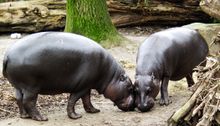
The Pygmy Hippopotamus (Choeropsis liberiensis) is a large mammal native to the forests and swamps of western Africa (the species name, meaning "of Liberia", reflects this). It is one of only four animals in the hippopotamus family. Unlike its larger relative, the Hippopotamus, relatively little is known about the Pygmy Hippo's diet or behaviour, although it is clear that the Pygmy Hippo is adapted to forest environments rather than the more open plains and grasslands that the Hippopotamus prefers.Pygmy Hippos stand about 75 cm (30 inches) high at the shoulder and weigh 180 kilograms (400 pounds). They are more solitary than their larger relatives and considerably less aquatic. The skin is greenish-black, shading to a creamy gray on the lower body. The average lifespan is 35 years, and one in captivity reached the age of 42. The gestation period ranges from 190-210 days, and usually a single young is born. Pygmy Hippos live either alone or in small groups, typically a mated pair and one calf.
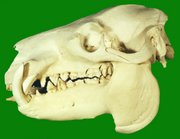 skull
All species of hippo spend most of their time in the water, emerging mainly at night in order to feed on land. The Pygmy Hippo is half as tall as the Hippopotamus and weighs 1/10 as much as a small member of the larger hippo species. The fossil record suggests that the Pygmy Hippo is closer in form and possibly behaviour to the common ancestor.
|
Change Text Size:
[A]
[default]
[A] |



 |
|
|
|
|


