 |
|
|
|
Tue, 15 Sep, 2026
|

|
|

Pay as you go
No monthly charges. Access for the price of a phone call
Go>
Unmetered
Flat rate dialup access from only £4.99 a month Go>
Broadband
Surf faster from just £13.99 a month Go> |
Save Even More
Combine your phone and internet, and save on your phone calls
More Info> |
This weeks hot offer
 24: Series 5
In association with Amazon.co.uk £26.97 |
|
|
? Salamanders |
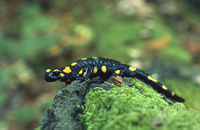
Salamandra salamandra
|
| Scientific classification |
| Kingdom: |
Animalia
|
| Phylum: |
Chordata
|
| Class: |
Amphibia
|
| Subclass: |
Lissamphibia
|
| Order: |
Caudata/Urodela
|
|
|
|
|
|
|
Suborders
|
Cryptobranchoidea
Salamandroidea
Sirenoidea
|
Salamander is the common name applied to approximately 500 amphibian vertebrates with slender bodies, short legs, and long tails (order Caudata or Urodela). The moist skin of the amphibians limits them to habitats either near water or under some protection on moist ground, usually in a forest. Some species are aquatic throughout life, some take to the water intermittently, and some are entirely terrestrial as adults. Salamanders superficially resemble lizards, but are easily distinguished by their lack of scales. They are capable of regenerating lost limbs.The female members of the suborder Salamandroidea have cloacal glands in their cloacal chamber called spermathecae used to store sperm, as well as cloacal lips to pick up the male spermatophores.Adult salamanders who retain their external gills are called perennibranchiate species.Species of salamanders are numerous and found in most moist or aqueous habitats in the northern hemisphere. Most are small but some reach up to 5 feet in length. They live in brooks and ponds and other moist locations. North America has the hellbender and the mudpuppy which can reach the length of a foot or more. In Japan and China the giant salamander is found, which reaches 5 feet (1.5m) and weighs up to 30 kilograms [1] [2].Salamanders are generally restricted to the northern hemisphere, with the exception of a few species in the northernmost part of South America.
 Mythology - Contents Mythology - Contents
The mythical salamander resembles the real salamander somewhat in appearance, but makes its home in fires, the hotter the better. (Similarly, the salamander in heraldry is shown in flames, but is otherwise depicted as a generic lizard.) Early travelers to China were shown garments which, or so they were told, had been woven of wool from the salamander: the cloth was completely unharmed by fire. The garments had actually been woven from asbestos. Later Paracelsus suggested that the salamander was the elemental of fire.These myths originate in Europe from the fire salamander, Salamandra salamandra, which hibernates in and under rotting logs. When logs were brought indoors and put on the fire, the animals mysteriously appeared from the flames.Salamanders are also magical beasts frequently mentioned in the Harry Potter series.
Classification - Contents
There are ten families belonging to the order Urodela, divided into three suborders:
- Suborder Cryptobranchoidea (giant salamanders)
-
Cryptobranchidae ( giant salamanders)
-
Hynobiidae ( Asiatic salamanders)
- Suborder Salamandroidea (advanced salamanders)
-
Ambystomatidae ( mole salamanders)
-
Amphiumidae ( amphiumas or Congo eels)
-
Dicamptodontidae ( Pacific giant salamanders)
-
Plethodontidae ( lungless salamanders)
-
Proteidae ( mudpuppies and waterdogs)
-
Rhyacotritonidae ( torrent salamanders)
-
Salamandridae ( true salamanders and newts)
- Suborder Sirenoidea (sirens)
|
Change Text Size:
[A]
[default]
[A] |



 |
|
|
|
|


