 |
|
|
|
Tue, 15 Sep, 2026
|

|

|
|
? Shrimp |
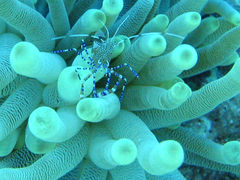
Spotted cleaner shrimp
(Periclimenes yucatanicus)
|
| Scientific classification |
| Kingdom: |
Animalia
|
| Phylum: |
Arthropoda
|
| Subphylum: |
Crustacea
|
| Class: |
Malacostraca
|
| Order: |
Decapoda
|
| Suborder: |
Pleocyemata
|
| Infraorder: |
Caridea
Dana, 1852 |
|
|
|
|
|
|
Superfamilies and families
|
Alpheoidea
-
Alpheidae - snapping shrimps
-
Barbouriidae
-
Hippolytidae
-
Ogyrididae
Atyoidea
-
Atyidae
Bresilioidea
-
Agostocarididae
-
Alvinocarididae
-
Bresiliidae
-
Disciadidae
-
Mirocarididae
Campylonotoidea
-
Bathypalaemonellidae
-
Campylonotoidae
Crangonoidea
-
Crangonidae
-
Glyphocrangonidea
Galatheacaridoidea
-
Galatheacarididae
Nematocarcinoidea
-
Eugonatonotidae
-
Nematocarcinidae
-
Rhynchocinetidae
-
Xiphocarididae
Oplophoroidea
-
Oplophoridae
Palaemonoidea
-
Anchistioididae
-
Desmocarididae
-
Euryrhynchidae
-
Gnathophyllidae
-
Hymenoceridae
-
Kakaducarididae
-
Palaemonidae
-
Typhlocarididae
Pandaloidea
-
Pandalidae
-
Thalassocarididae
Pasiphaeoidea
-
Pasiphaeidae
Procaridoidea
-
Procarididae
Processoidea
-
Processidae
Psalidopodoidea
-
Psalidopodidae
Stylodactyloidea
-
Stylodactylidae
|
True shrimp are small, swimming, decapod crustaceans classified in the infraorder Caridea, found widely around the world in both fresh and salt water.
 Jump to Page Contents Jump to Page Contents
|
|

Pay as you go
No monthly charges. Access for the price of a phone call
Go>
Unmetered
Flat rate dialup access from only £4.99 a month Go>
Broadband
Surf faster from just £13.99 a month Go> |
Save Even More
Combine your phone and internet, and save on your phone calls
More Info> |
This weeks hot offer
 24: Series 5
In association with Amazon.co.uk £26.97 |
|
Contents
Taxonomy
Shrimp as food
Shrimps in aquaria
Taxonomy note
Taxonomy - Contents
A number of more or less unrelated crustaceans also have the word "shrimp" in their common name. Examples are the mantis shrimp and the opposum or mysid shrimp, both of which belong to the same class ( Malacostraca) as the true shrimp, but constitute two different orders within it, the Stomatopoda and the Mysidacea. Triops longicaudatus or Triops cancriformis are also popular animals in freshwater aquaria, and are often called shrimp, although they belong instead to the Notostraca, a quite unrelated group.Shrimp are distinguished from the superficially similar prawns by the structure of the gills, and by the fact that female shrimp (as in all other pleocyemates) brood the eggs on their pleopods. There is, however, much confusion between the two, especially among non-specialists, and many shrimp are called "prawns" and many prawns are called "shrimp". This is particularly widespread in culinary contexts, including the following sections.
Shrimp as food - Contents
 A steamed tail-on shrimp
A number of the larger species, including the white shrimp Penaeus setiferus, are caught commercially and used for food. Recipes utilizing shrimp form part of the cuisine of many cultures: examples include jambalaya, okonomiyaki, poon choi, bagoong, Kerala and scampi.Preparing shrimp for consumption usually involves removing the shell, tail, and "sand vein" (a euphemism for digestive tract). As with other seafood, shrimp is high in calcium, protein and low in food energy.
Shrimp preparation
To deshell the shrimp, first hold onto the tail while gently removing the shell around the body. The tail can be detached completely at this point, or left attached for presentation purposes. The "vein" is then removed; make a shallow cut lengthwise down the outer curve of the shrimp's body. Pick out the dark ribbon-like vein running lengthwise along the shrimp's back with a pointed utensil. Then rinse the shrimp under cold running water. If you have detached the tail, you can pinch the vein at the tail end and pull it completely out with your fingers.
Shrimps in aquaria - Contents
 Japanese marsh shrimp Caridina japonica
Several types of shrimp are kept in home aquaria and are useful in controlling algae and removing debris. Freshwater shrimp available for aquaria include the Japanese marsh shrimp (Caridina japonica) and ghost or glass shrimps (Palaeomonetes sp.) Popular saltwater shrimp include the cleaner shrimp Lysmata amboinensis, the Fire shrimp (Lysmata debelius) and the Harlequin shrimp (Hymenocera picta).
Taxonomy note - Contents
The shrimp genus Physetocaris, previously given its own superfamily ( Physetocaridoidea) and family ( Physetocarididae) is now merged with family Pandalidae. |
Change Text Size:
[A]
[default]
[A] |



 |
|
|
|
|

