 |
|
|
|
Sun, 26 Jul, 2026
|

|
|

Pay as you go
No monthly charges. Access for the price of a phone call
Go>
Unmetered
Flat rate dialup access from only £4.99 a month Go>
Broadband
Surf faster from just £13.99 a month Go> |
Save Even More
Combine your phone and internet, and save on your phone calls
More Info> |
This weeks hot offer
 24: Series 5
In association with Amazon.co.uk £26.97 |
|
 Focal plane
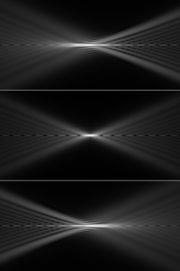 Longitudinal sections
In optics, spherical aberration is an image imperfection that occurs due to the increased refraction of light rays that occurs when rays strike a lens or mirror near its edge, in comparison with those that strike nearer the center. It is often considered to be an imperfection of telescopes and other instruments which makes their focusing less than ideal due to the spherical shape of lenses and mirrors. This is an important effect, as spherical shapes are much easier to produce than aspherical and so most lenses have spherical shapes.The effect is proportional to the fourth power of the diameter and inversely proportional to the third power of the focal length, so it is much more pronounced at short focal ratios, i.e., "fast" lenses.For small telescopes using spherical mirrors with focal ratios shorter than f/10, light from a distant point source (such as a star) is not all focused at the same point. Particularly, light striking the inner part of the mirror focuses further from the mirror than light striking the outer part. As a result the image cannot be focused as sharply as if the aberration were not present. Because of spherical aberration, telescopes shorter than f/10 are usually made with non-spherical mirrors or with correcting lenses.In lens systems, the effect can be minimized using special combinations of convex and concave lenses, as well as using aspheric lenses. |
Change Text Size:
[A]
[default]
[A] |



 |
|
|
|
|


