 |
|
|
|
Mon, 14 Sep, 2026
|

|

|
A spiral galaxy is a type of galaxy in the Hubble sequence which is characterized by the following physical properties:
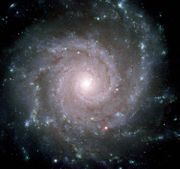
Spiral Galaxy M74 presents a face-on view of its spiral arms. It contains about 100 billion stars, 30 million light-years away toward the constellation Pisces.
- A considerable total angular momentum
- Composed of a central bulge surrounded by a disk
- The bulge resembles an elliptical galaxy, containing many old, so-called " Population II" stars, and usually a supermassive black hole at its center.
- The disk is a flat, rotating assembly consisting of interstellar matter, young " Population I" stars and open star clusters.
Spiral galaxies are so named due to the bright arms of star formation within the disk that extend—roughly logarithmically—from the bulge. Though sometimes difficult to discern, such as in flocculent spirals, these arms distinguish spiral galaxies from their lenticular counterparts, which exhibit a disk structure but no evident spiral.The disks of spiral galaxies tend to be surrounded by large spheroid halos of Population II stars, many of which are concentrated in globular clusters that orbit the galactic center.Our galaxy, the Milky Way, has long been thought to be a spiral, with a Hubble sequence classification of Sbc (possibly SBb); recent research, however, suggests that it may in fact be a barred spiral.
 Jump to Page Contents Jump to Page Contents
|
|

Pay as you go
No monthly charges. Access for the price of a phone call
Go>
Unmetered
Flat rate dialup access from only £4.99 a month Go>
Broadband
Surf faster from just £13.99 a month Go> |
Save Even More
Combine your phone and internet, and save on your phone calls
More Info> |
This weeks hot offer
 24: Series 5
In association with Amazon.co.uk £26.97 |
|
Contents
Origin of the spiral structure
Examples
Origin of the spiral structure - Contents
The early pioneer of studies on the formation of the spiral arms was Bertil Lindblad. He realised that the idea of stars arranged permanently in a spiral shape was untenable due to the "winding dilemma". Since the speed of rotation of the galactic disk varies with distance from the centre of the galaxy, a radial arm (like a spoke) would quickly become curved as the galaxy rotates. The arm would, after a few galactic rotations, become increasingly curved and wind around the galaxy ever tighter. This is not what is observed.
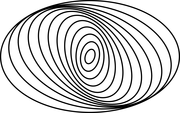 Explanation of spiral galaxy arms.
The first acceptable theory was devised by C. C. Lin and Frank Shu in 1964. They suggested that the spiral arms were manifestations of spiral density waves. They assumed that the stars travel in slightly elliptical orbits and that the orientations of their orbits is correlated i.e. the ellipses vary in their orientation (one to another) in a smooth way with increasing distance from the galactic centre. This is illustrated in the diagram. It is clear that the elliptical orbits come close together in certain areas to give the effect of arms. Stars therefore do not remain forever in the position that we now see them in, but pass through the arms as they travel in their orbits.Alternative hypotheses that have been proposed involve waves of star formation moving about the galaxy; the bright stars produced by the star formation die out quickly, leaving darker regions behind the waves, and hence making the waves visible.
Examples - Contents
-
Andromeda
-
Triangulum
-
Whirlpool
|
Change Text Size:
[A]
[default]
[A] |



 |
|
|
|
|

