|
|
|
|
Mon, 14 Sep, 2026
|

|
|

Pay as you go
No monthly charges. Access for the price of a phone call
Go>
Unmetered
Flat rate dialup access from only £4.99 a month Go>
Broadband
Surf faster from just £13.99 a month Go> |
Save Even More
Combine your phone and internet, and save on your phone calls
More Info> |
This weeks hot offer
 24: Series 5
In association with Amazon.co.uk £26.97 |
|
Contents
 History History
History - Contents
The ancestors of the St. Bernard were the herding dogs of Swiss farmers as well as hunting dogs and watchdogs. Their history has also been connected with the hospice at the Great St. Bernard Pass. First reports of the dogs' presence at the pass date to the 17th century, and they remained loyal companions to the monks there until 2004, when the monks began to divest themselves of the dogs and focus the time they spent on the dogs to minister to people.The most famous St. Bernard to save people at the pass was Barry (sometimes spelled Berry), who reportedly saved somewhere between 40 and 100 lives. There is a monument to Barry in the Cimetière des Chiens and his body was preserved in the Natural History Museum in Berne [2].
Varieties
The St. Bernard originally was a smooth-coated dog developed to rescue travellers from the snow. In the 1830s the monks who owned and bred the dogs introduced Newfoundland blood to strengthen the breed, and this gave rise to the rough-coat St. Bernard. Although more popular, the rough-coat variety proved to be unsuitable for mountain work because the long hair tended to collect icicles. For this reason the monks kept the smooth coat variety for rescue work.
Temperament
St. Bernards are very gentle giants. They are extremely fond of children and are loyal to their family, but, as with any dog, should not be left unsupervised with young children.
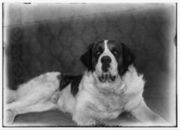 Scipio, a St. Bernard dog belonging to Orville Wright
Health
The very fast growth rate and the weight of a St Bernard can lead to very serious deterioration of the bones if the dog does not get proper food and exercise. Some dogs are affected by hip dysplasia. They are also prone to eczema. |
Change Text Size:
[A]
[default]
[A] |



 |
|
|
|
|