 |
|
|
|
Thu, 01 Oct, 2026
|

|

|
|
? Sumac |
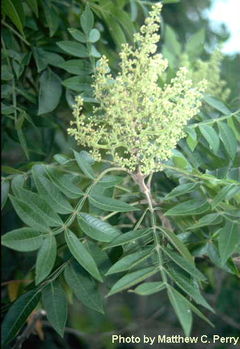
Winged Sumac leaves and flowers
|
| Scientific classification |
| Kingdom: |
Plantae
|
| Division: |
Magnoliophyta
|
| Class: |
Magnoliopsida
|
| Order: |
Sapindales
|
| Family: |
Anacardiaceae
|
| Genus: |
Rhus
L. |
|
|
|
|
|
|
Species
|
| About 250 species; see text
|
Rhus is a genus approximately 250 species of woody shrubs and small trees in the family Anacardiaceae. They are commonly called sumac or sumach. Some species (including poison-ivy, poison-oak, and poison sumac), often placed in this genus, are here treated in the genus Toxicodendron, which differs in highly allergenic foliage and grayish-white fruit but is not genetically distinct. The name derives from the Greek name for sumac, rhous.
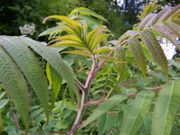 A young branch of Staghorn Sumac.
The leaves are spirally arranged; they are usually pinnately compound, though some species have trifoliate or simple leaves. The flowers are in dense panicles or spikes 5-30 cm long, each flower very small, creamy white, greenish or red, with five petals. The fruit form dense clusters of reddish drupes.The genus is found in subtropical and warm temperate regions throughout the world, with the highest diversity in southern Africa.
 Jump to Page Contents Jump to Page Contents
|
|

Pay as you go
No monthly charges. Access for the price of a phone call
Go>
Unmetered
Flat rate dialup access from only £4.99 a month Go>
Broadband
Surf faster from just £13.99 a month Go> |
Save Even More
Combine your phone and internet, and save on your phone calls
More Info> |
This weeks hot offer
 24: Series 5
In association with Amazon.co.uk £26.97 |
|
Contents
Cultivation and uses
Propagation
Species
Cultivation and uses - Contents
The hairy covering of the drupes is harvested and used as a spice (a deep red powder with a sour taste) in some Middle Eastern countries. In North America, the smooth sumac, Rhus glabra, and the staghorn sumac, Rhus typhina, are sometimes used to make a beverage, termed "sumac-ade" or "Indian lemonade" or "rhus juice". This drink is made by soaking the drupes in cool water, rubbing the active principle off the drupes, then straining the liquid through a cotton cloth and sweetening it. Native Americans also used the leaves and berries of the smooth and staghorn sumacs combined with tobacco in traditional smoking mixtures.Species including the fragrant sumac Rhus aromatica, the littleleaf sumac, R. microphylla, the skunkbush sumac, R. trilobata, the smooth sumac, and the staghorn sumac are grown for ornament, either as the wild type or as cultivars.The berries of certain sumacs native to Japan and China, such as Rhus verniciflua (Japanese sumac tree) and Rhus succedanea (Japanese wax tree), are used to make japan wax.
Propagation - Contents
Sumac propagates both by seeds, which are spread by birds and other animals through feces, and new sprouts from roots, forming large clonal colonies. Mowing of sumac is not a good control measure as the wood is springy resulting in jagged, sharp pointed stumps when mowed. The plant will quickly recover with new growth after mowing. See Nebraska Extension Service publication G97-1319 for suggestions as to control.
Species - Contents
Species in Africa:
- Rhus dentata
- Rhus laevigata
- Rhus lancea (Willow Rhus)
- Rhus leptodictya (Mountain Karee)
- Rhus lucida (Shiny-leaved Rhus)
- Rhus pendulina (White Karee)
- Rhus pyroides
- Rhus viminalis
- Rhus zeyheri
Species in Asia:
- Rhus chinensis (Chinese Sumac)
- Rhus hypoleuca
- Rhus javanica
- Rhus punjabensis (Punjab Sumac)
Species in Australia:
Species in the Mediterranean region:
- Rhus coriaria (Tanner's Sumac)
- Rhus pentaphylla
- Rhus tripartita
Species in eastern North America:
- Rhus aromatica (Fragrant Sumac)
- Rhus copallina (Winged Sumac or Shining Sumac)
- Rhus glabra (Smooth Sumac)
- Rhus lanceolata (Prairie Sumac)
- Rhus michauxii (Michaux's Sumac) Conservation status: Endangered
- Rhus typhina (Staghorn Sumac)
- (Rhus toxicodendron = Toxicodendron radicans)
Species in western North America include:
- Rhus choriophylla
- Rhus laurina (Laurel Sumac)
- Rhus integrifolia (Lemonade Sumac)
- Rhus microphylla (Desert Sumac), Littleleaf sumac
- Rhus ovata (Sugar Sumac)
- Rhus trilobata (Skunkbush Sumac)
- Rhus virens (Evergreen Sumac)
Species in Mexico and Central America include:
- Rhus muelleri (Müller's Sumac; northeast Mexico) Conservation status: Endangered
Species in the Pacific (Oceania):
- Rhus sandwicensis A. Gray is an endemic species from the Hawaiian Islands called Neleau.
|
Change Text Size:
[A]
[default]
[A] |



 |
|
|
|
|

