 |
|
|
|
Fri, 16 Oct, 2026
|

|

|
|
? Vole |
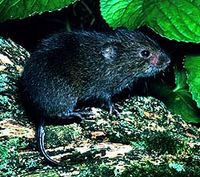
Meadow vole, Microtus pennsylvanicus
|
| Scientific classification |
|
|
|
|
|
Genera
|
Microtus
Myodes
Phenacomys
Lagurus
Arvicola
|
A vole is a small rodent resembling a mouse but with a stouter body; a shorter, hairy tail; and smaller ears and eyes.
 Jump to Page Contents Jump to Page Contents
|
|

Pay as you go
No monthly charges. Access for the price of a phone call
Go>
Unmetered
Flat rate dialup access from only £4.99 a month Go>
Broadband
Surf faster from just £13.99 a month Go> |
Save Even More
Combine your phone and internet, and save on your phone calls
More Info> |
This weeks hot offer
 24: Series 5
In association with Amazon.co.uk £26.97 |
|
Contents
Description
Habitat
Range
Diet
Predators
Age
Popular Culture
Description - Contents
Most vole species have rootless molars that fold into a series of triangles. Voles are one of the few rodents whose molars continue to grow during their entire life. There is little to distinguish a vole from a lemming.All rodents have incisors that grow continuously.Adult voles, depending on the species, are three to seven inches long.
Habitat - Contents
Voles live in a variety of environments. The North American meadow vole lives in networks of above-ground "runways" in grassy areas, as well as underground burrows. California's red vole lives in the tree tops.
Range - Contents
Sometimes known as field mice in America, approximately 70 species of voles can be found in Europe, Asia, North Africa and North America.
Diet - Contents
Depending on the species, the Vole's diet consists of seeds, tubers, conifers needles, bark, various green vegetation such as grass and clover, and insects.
Predators - Contents
Most carnivores such as wolves, owls, hawks, coyotes, foxes, weasels, and cats eat voles.
Age - Contents
The average life of a vole is between 3-6 months. Voles rarely live longer than 12 months. The longest lifespan of a vole ever recorded was 18 months.
Popular Culture - Contents
The character of Ratty in The Wind in the Willows is actually a water vole, not a rat.
|
Change Text Size:
[A]
[default]
[A] |



 |
|
|
|
|

