 |
|
|
|
Tue, 15 Sep, 2026
|

|
|

Pay as you go
No monthly charges. Access for the price of a phone call
Go>
Unmetered
Flat rate dialup access from only £4.99 a month Go>
Broadband
Surf faster from just £13.99 a month Go> |
Save Even More
Combine your phone and internet, and save on your phone calls
More Info> |
This weeks hot offer
 24: Series 5
In association with Amazon.co.uk £26.97 |
|
|
? African Buffalo
Conservation status: Lower risk (cd)
|
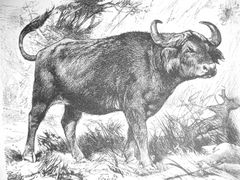
19th century drawing
|
| Scientific classification |
| Kingdom: |
Animalia
|
| Phylum: |
Chordata
|
| Class: |
Mammalia
|
| Order: |
Artiodactyla
|
| Family: |
Bovidae
|
| Genus: |
Syncerus
Hodgson, 1847 |
| Species: |
S. caffer
|
|
|
|
|
|
|
|
Syncerus caffer
( Sparrman, 1779) |
|
Subspecies
|
S. c. caffer
S. c. nanus
S. c. brachyceros
S. c. mathewsi
|
The African Buffalo or Cape Buffalo (Syncerus caffer) is a bovid from the family of the Bovidae. It is up to 1.7 meters high, 3.4 meters long, and can reach a weight of 900 kilograms.
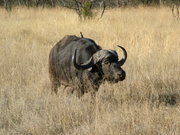 An African Buffalo Bull.
The Cape Buffalo is not closely related to the Asian Water Buffalo, but its ancestry remains unclear. It is a very powerful creature, demanding respect from even a pride of lions when paths cross. Other than man, they have few natural predators and are capable of defending themselves against (and sometimes killing) lions, who will attack only old, sick, or immature buffaloes. The leopard is a threat only to newborn calves. Crossbreeding with domestic cattle has had only limited success, and the African Buffalo remains a wild animal.Known as one of the " big five" in Africa, the Cape Buffalo can be a volatile and formidable beast.Cape Buffalo prefer areas of open pasture, close to jungle and swampy ground where they can wallow. They are found in Ethiopia, Somalia, Zimbabwe, Namibia, Botswana, Mozambique and South Africa, with a significant seasonal presence in Kenya and Tanzania.The main herd consists of all sexes and ages, though bachelor groups are also found. A male is recognizable by the thickness of his horns, and is called the "Boss." Bulls mature at eight years of age. Cows first calve at five years of age, after a gestation period of 11.5 months. |
Change Text Size:
[A]
[default]
[A] |



 |
|
|
|
|


