 |
|
|
|
Thu, 01 Oct, 2026
|

|
|

Pay as you go
No monthly charges. Access for the price of a phone call
Go>
Unmetered
Flat rate dialup access from only £4.99 a month Go>
Broadband
Surf faster from just £13.99 a month Go> |
Save Even More
Combine your phone and internet, and save on your phone calls
More Info> |
This weeks hot offer
 24: Series 5
In association with Amazon.co.uk £26.97 |
|
|
? Asafoetida |
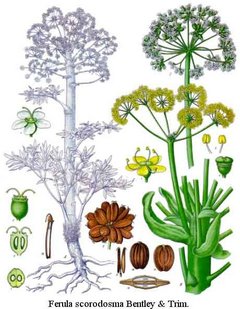
Ferula scorodosma syn. assafoetida
|
| Scientific classification |
| Kingdom: |
Plantae
|
| Division: |
Magnoliophyta
|
| Class: |
Magnoliopsida
|
| Order: |
Apiales
|
| Family: |
Apiaceae
|
| Genus: |
Ferula
|
| Species: |
F. assafoetida
|
|
|
|
|
|
|
|
Ferula assafoetida
L. |
|
|
Asafoetida (Ferula assafoetida, family Apiaceae) is a species of Ferula native to Iran. It is a herbaceous perennial plant growing to 2 m tall, with stout, hollow, somewhat succulent stems 5-8 cm diameter at the base of the plant. The leaves are 30-40 cm long, tripinnate or even more finely divided, with a stout basal sheath clasping the stem. The flowers are yellow, produced in large compound umbels.Asafoetida's English and scientific name is derived from the Persian word for resin (asa) and Latin foetida, which refers to its strong sulfurous odour. Its pungent odour has resulted in its being called by many unpleasant names; thus in French it is known (among other names) as Merde du Diable (Devil's faeces); in some dialects of English too it was known as Devil's Dung, and equivalent names can be found in most Germanic languages (e.g. German Teufelsdreck), and also Finnish Pirunpaska. In Turkish, it is known as Şeytantersi, Şeytan bökösu or Şeytanotu (the Devil's Herb). In many of the northern Indian languages ( Hindi, Urdu, Gujarati, Punjabi, Marathi, Bengali) it is known as hing. A related name occurs in many Dravidian languages (e.g. Telugu Inguva, Kannada Ingu), but in Tamil, it is known as perungaayam.
Cultivation and uses
The resin-like gum which comes from the dried sap extracted from the stem and roots is used as a spice. The resin is greyish-white when fresh, but dries to a dark amber colour. Chunks of asafoetida resin are too hard to be grated easily, and traditionally crushed between stones or with a hammer. Today, the most commonly available form is compounded asafoetida, a fine powder containing 30% asafoetida resin, along with rice flour and gum arabic.
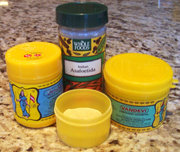 Jars of commercially available asafoetida powder.
This spice is used as a digestive aid, in food as a condiment and in pickles. Its odour is so strong that it must be stored in airtight containers; otherwise the aroma, which is nauseating in quantities, will contaminate other spices stored nearby. However, its smell becomes much milder in cooking and presents an onion-like taste. In India, it is used especially by the Brahmin caste of the Hindus and by adherents of Jainism, who are not allowed to eat onions. It is mainly grown in Iran, Afghanistan and Kashmir.Asafoetida has certain medicinal uses and most commonly is used as a digestive aid. It is reputed to lessen flatulence and is often added to lentil or eggplant dishes in small quantities. It is also said to be helpful in cases of asthma and bronchitis. In the Appalachian region of the United States, it was used as a folk remedy for children's colds: it is mixed into a foul-smelling paste and hung in a bag around the afflicted child's neck. In Thailand it is used to aid babies' digestion and is smeared on the child's stomach in an alcohol tincture known as "mahahing".
|
Change Text Size:
[A]
[default]
[A] |



 |
|
|
|
|


