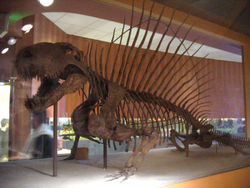
Dimetrodon (dy-MET-ro-don) was a predatory synapsid (mammal-like "reptile") genus that flourished during the Permian period, living between 280 and 260 million years ago. It is more closely related to mammals than to true reptiles ( Sauropsida) like dinosaurs, lizards and birds. Dimetrodon was not a dinosaur, despite being popularly grouped with them; rather, it is classified as a pelycosaur. It is surprisingly well known to the general public: it makes an appearance in the James Mason film Journey to the Center of the Earth.Dimetrodon was a dominant carnivore, the largest of its day. It grew to up to 3 meters in length. Dimetrodon means "two-measures teeth"; it is so named because it had a large skull with two different types of teeth (shearing teeth and sharp canine teeth), as opposed to the dinosaurs. It walked on four side-sprawling legs and had a large tail.Dimetrodon's most distinctive characteristic is the spectacular sail on its back. The sail was probably used to regulate body temperature; the surface area would allow it to warm up or cool off more efficiently. It may also have been used in mating rituals and to ward off other predators. The sail was supported by neural spines, each one sprouting from an individual vertebra.