 |
|
|
|
Wed, 16 Sep, 2026
|

|

|
|
? Gray Reef Shark
Conservation status: Lower risk (nt)
|
|
| Scientific classification |
| Kingdom: |
Animalia
|
| Phylum: |
Chordata
|
| Class: |
Chondrichthyes
|
| Subclass: |
Elasmobranchii
|
| Order: |
Carcharhiniformes
|
| Family: |
Carcharhinidae
|
| Genus: |
Carcharhinus
|
| Species: |
C. amblyrhynchos
|
|
|
|
|
|
|
|
Carcharhinus amblyrhynchos
( Bleeker, 1856) |
|
|
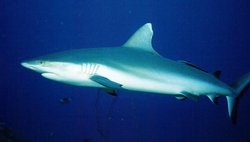
The Gray Reef Shark (Carcharhinus amblyrhynchos) is one of the most common sharks found around coral reefs of Indo-Pacific waters.
 Jump to Page Contents Jump to Page Contents
|
|

Pay as you go
No monthly charges. Access for the price of a phone call
Go>
Unmetered
Flat rate dialup access from only £4.99 a month Go>
Broadband
Surf faster from just £13.99 a month Go> |
Save Even More
Combine your phone and internet, and save on your phone calls
More Info> |
This weeks hot offer
 24: Series 5
In association with Amazon.co.uk £26.97 |
|
Contents
Distribution and Habitat
Anatomy
Behavior
Reproduction
Distribution and Habitat - Contents
The Gray reef shark is found from the Red sea to the easter islands from the surface to about 250 meters deapth in lagoons and close to islands and reefs.
Anatomy - Contents
As its name suggests, the shark is gray overall, with a white underside. The tips of most fins, except the first dorsal fin, are darker, and the trailing edge of the caudal fin has a prominent black margin. Some individuals have a white pattern on the leading edge of the dorsal fin. It has been recorded at up to 255 cm. The Blacktip Reef Shark looks similar, and also common, but is distinguished by a black tip on the first dorsal fin.
Behavior - Contents
They are active during the day, but more so at night, feeding on reef fishes, squids, octopus, and various crustaceans such as crabs and shrimp.This species is social, aggregating in favored areas, often near dropoffs at the edge of a reef, or in atoll passes where there is a strong current. They are often curious, will investigate human scuba divers, and have been implicated in attacks, although there is some debate as to whether the sharks are fundamentally aggressive or have simply reacted badly to perceived threats by divers. They have been observed to adopt a distinctive "hunching" posture when feeling threatened, the body bent into a sort of "S" shape.
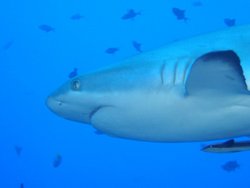 A Grey Reef Shark.
Reproduction - Contents
Reproduction is viviparous, with 1-6 pups in a litter. The numbers of Gray Reef Sharks have declined in recent years. |
Change Text Size:
[A]
[default]
[A] |



 |
|
|
|
|

