 |
|
|
|
Wed, 16 Sep, 2026
|

|
|

Pay as you go
No monthly charges. Access for the price of a phone call
Go>
Unmetered
Flat rate dialup access from only £4.99 a month Go>
Broadband
Surf faster from just £13.99 a month Go> |
Save Even More
Combine your phone and internet, and save on your phone calls
More Info> |
This weeks hot offer
 24: Series 5
In association with Amazon.co.uk £26.97 |
|
| Mount Cameroon |
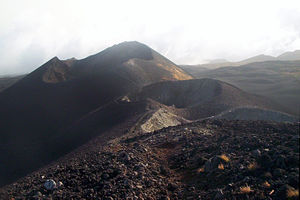
Craters from the 2000 eruptions |
|
Elevation: |
4,095 m (13,435 ft) |
| Location: |
Southwest Province, Cameroon |
|
Prominence: |
3,961 m (12,995 ft) |
|
Coordinates: |
4°12′N, 9°11′E |
|
Type: |
stratovolcano |
|
Age of rock: |
? yr |
| Last eruption: |
2000 |
|
First ascent: |
1861 by Sir Richard Francis Burton |
| Easiest route: |
scramble |
Mount Cameroon (also known as Cameroon Mountain or Fako) is an active volcano in Cameroon, near the Gulf of Guinea and is part of a general area of volcanic activity the Cameroon Volcanic Line, which also includes Lake Nyos, the site of the 1986 Lake Nyos tragedy. The volcano last erupted on March 28, 1999 and May 28, 2000.Mt. Cameroon, one of Africa's largest volcanoes, rises to 4095 m above the coast of west Cameroon. The massive steep-sided volcano of dominantly basaltic-to-trachybasaltic composition forms a volcanic horst constructed above a basement of Precambrian metamorphic rocks covered with Cretaceous to Quaternary sediments. More than 100 small cinder cones, often fissure-controlled parallel to the long axis of the massive 1400 cu km volcano, occur on the flanks and surrounding lowlands. A large satellitic peak, Etinde (also known as Little Cameroon), is located on the southern flank near the coast. Historical activity, the most frequent of west African volcanoes, was first observed in the 5th century BC by the Carthaginian navigator Hannon. During historical time, moderate explosive and effusive eruptions have occurred from both summit and flank vents. A 1922 SW-flank eruption produced a lava flow that reached the Atlantic coast, and a lava flow from a 1999 south-flank eruption stopped only 200 m from the sea.The peak can be reached by hikers, while the annual Mount Cameroon Race scales the peak in around 4½ hours.English explorer Mary Kingsley, one of the first Europeans to scale the mountain, recounts her expedition in her 1897 memoir Travels in West Africa. |
Change Text Size:
[A]
[default]
[A] |



 |
|
|
|
|


