 |
|
|
|
Tue, 15 Sep, 2026
|

|

|
|
? Sockeye salmon |
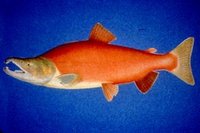
Spawning sockeye salmon
|
| Scientific classification |
| Kingdom: |
Animalia
|
| Phylum: |
Chordata
|
| Class: |
Actinopterygii
|
| Order: |
Salmoniformes
|
| Family: |
Salmonidae
|
| Genus: |
Oncorhynchus
|
| Species: |
O. nerka
|
|
|
|
|
|
|
|
Oncorhynchus nerka
( Walbaum, 1792) |
|
|
Sockeye Salmon (Oncorhynchus nerka), also called Red Salmon or Blueback Salmon, is an anadromous species of salmon found in the Pacific Ocean. The same species when it occurs in landlocked bodies of water is called the Kokanee.
 Jump to Page Contents Jump to Page Contents
|
|

Pay as you go
No monthly charges. Access for the price of a phone call
Go>
Unmetered
Flat rate dialup access from only £4.99 a month Go>
Broadband
Surf faster from just £13.99 a month Go> |
Save Even More
Combine your phone and internet, and save on your phone calls
More Info> |
This weeks hot offer
 24: Series 5
In association with Amazon.co.uk £26.97 |
|
Contents
Range
Physical Description
Reproduction
Ecology/Behaviour
Commerce
Range - Contents
Its range is as far as south as the Klamath River in California in the eastern Pacific and northern Hokkaido Island in Japan in the western Pacific, and as far north as Bathurst Inlet in the Canadian Arctic in the east and the Anadyr River in Siberia in the west. Landlocked populations occur in the Yukon Territory and British Columbia in Canada, and in Alaska, Washington, Montana and Oregon in the United States.
Physical Description - Contents
A Sockeye can be as long as 84 cm and weigh 6 to 8 pounds (2.5 to 3.5 kilos). It has an elongate, torpedo shaped body, with adipose fins, and a bluntly pointed snout. The gill rakers located just behind the head are long and closely spaced. Its colouration changes as it switches from freshwater to saltwater. In freshwater, its colour is bright red with a pale green head; females may have green and yellow marks stains. Its colour in saltwater is bluish-green on top, silvery on the bottom, with uniform, shiny skin.
Reproduction - Contents
Prior to spawning the sockeye are blue tinged with silver in colour during their ocean life. The males develop a hump on their back and their jaw and teeth become hooked when they move from salt to fresh water. Males and females both turn red green heads, and a dark stripe on their sides prior to spawning.Sockeye salmon spawn only in streams having lakes in their watershed. The young fish, known as fry, spend one to three years in the freshwater before migrating to the ocean, some stay in the lake and do not migrate to the sea. The fish that migrate spend three to four years in the salt water, and thus are four to six years old when they return to spawn in autumn (September-December). Migration back to the home river, is thought to be done using the characteristic smell of the stream, and possibly the sun.Some young fish spend as long as four years in fresh water lakes before migrating to the sea. In rivers without lakes, many of the young move to the ocean quite soon after hatching. These salmon mature after one to four years in the ocean. Some Sockeye Salmon live and reproduce in lakes and are called "kokanee." They are much smaller than the ones that go to the ocean and are rarely over 350mm (14 inches) long.
Ecology/Behaviour - Contents
Sockeyes, unlike the other species of Pacific Salmon, feed almost exclusively on plankton. They are able to do this as a result of their many gill rakers, which strain the plankton from the water. It is speculated that this diet is the reason for the striking hue of their flesh.
Commerce - Contents
This species is netted for commercial canning, especially in Bristol Bay, Alaska, site of the largest harvest of sockeye salmon in the world, according to the Alaska Department of Fish and Game. The species has been preferred for canning due to the rich orange-red colour of the flesh. More than half of the sockeye salmon caught today is sold frozen. Sockeye also tends to fetch a higher price then all other salmon when sold fresh. |
Change Text Size:
[A]
[default]
[A] |



 |
|
|
|
|


