|
|
|
|
Tue, 15 Sep, 2026
|

|
|

Pay as you go
No monthly charges. Access for the price of a phone call
Go>
Unmetered
Flat rate dialup access from only £4.99 a month Go>
Broadband
Surf faster from just £13.99 a month Go> |
Save Even More
Combine your phone and internet, and save on your phone calls
More Info> |
This weeks hot offer
 24: Series 5
In association with Amazon.co.uk £26.97 |
|
Contents
 Mission planning and launch Mission planning and launch
Jupiter
Saturn
Uranus
Neptune
Escaping the solar system
Current Position
Current Voyager 2 data processing and operations
Voyager 2 in fiction and popular culture
Mission planning and launch - Contents
![Voyager 2 Launch. [1]](http://www.zazizam.com/images/82/8273.jpg) Voyager 2 Launch. [1]
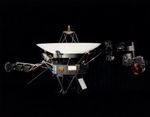
Voyager 2 was originally planned to be Mariner 12, part of the Mariner program.Voyager 2 was launched on August 20, 1977, from Cape Canaveral, Florida aboard a Titan III-E Centaur rocket.Ground crews became engrossed in a launch problem with Voyager 1 and forgot to send an important activation code to Voyager 2. This caused the probe to shut down its main high-gain antenna. Fortunately, ground crews were able to establish contact through the craft's low-gain antenna and activate it.
Jupiter - Contents
The closest approach to Jupiter occurred on July 9, 1979.
Saturn - Contents
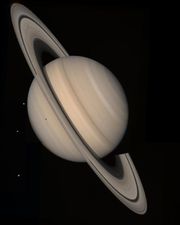 Saturn taken by Voyager 2
The closest approach to Saturn occurred on August 25, 1981.While behind Saturn (as viewed from Earth), Voyager 2 probed Saturn's upper atmosphere with its radar, to measure temperature and density profiles. Voyager 2 found that at the highest levels (70 millibars or 7.0 kilopascals) Saturn's temperature was 70 kelvins, while at the deepest levels measured (1200 millibars or 120 kilopascals) the temperature increased to 143 kelvins. The North pole was found to be 10 kelvins cooler, although this may be seasonal (see also Saturn Oppositions).After the Saturn fly-by, the camera platform on Voyager 2 locked up briefly, putting plans to officially extend the mission to Uranus and Neptune in jeopardy. Fortunately, the mission team were able to fix the problem, and the probe was given the go-ahead to examine Uranus.
Uranus - Contents
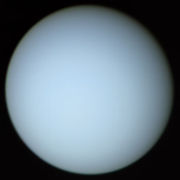 Uranus viewed from 18 million kilometers
The closest approach to Uranus occurred on January 24, 1986.Voyager 2 discovered 10 previously unknown moons; studied the planet's unique atmosphere, caused by its axial tilt of 97.77°; and examined its ring system.
Neptune - Contents
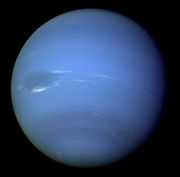 Voyager 2 image of Neptune
The closest approach to Neptune occurred on August 25, 1989. Since this was the last major planet Voyager 2 could visit, it was decided to make a close flyby of the moon Triton, regardless of the consequences to the trajectory, as with Voyager 1's encounter with Saturn and its moon Titan. This was a wise decision, as Triton turned out to have a fascinating surface.The probe also discovered the Great Dark Spot, which has since disappeared, according to Hubble Space Telescope observations.
Escaping the solar system - Contents
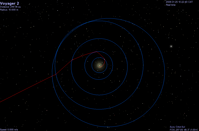
Since its planetary mission is over, Voyager 2 is now described as working on an Interspace Mission, which NASA is using to find out what the solar system is like beyond the heliosphere. Unlike Voyager 1, which is believed to have crossed the termination shock into the heliosheath in December 2004, Voyager 2 is currently not believed to have left the heliosphere yet.As of December 30, 2005, Voyager 2 is at a distance of 78.4 AU from Sun and is escaping the solar system at a speed of about 3.3 AU per year (ca. 15.6 km/s). Although it has not yet escaped the solar system, it is believed to be on the verge of doing so.Voyager 2 is expected to keep on transmitting into the 2030s.
Current Position - Contents
Voyager 2, as of January 2006, was at -52.41° declination and 19.688hrs Right Ascension, placing it in the constellation Telescopium.
Current Voyager 2 data processing and operations - Contents
There were 41.1 hours of DSN scheduled support for Voyager 2 of which 22.5 hours were large aperture coverage. There were no real-time or scheduled support changes or significant outages during the period.Science instrument performance was nominal for all activities during this period. One frame of GS-4 data was recorded this week. The EDR backlog is 2 days.Voyager 2 command operations consisted of the uplink of seven bracketed command loss timer resets sent on five-minute centers using 1.0 Hz steps on 03/16 [DOY 075/0342z]. The spacecraft received two of the seven commands sent.This information is available from: http://voyager.jpl.nasa.gov/mission/weekly-reports/index.htm
Voyager 2 in fiction and popular culture - Contents
Spoiler warning: Plot and/or ending details follow.
- The motion picture Starman portrayed Voyager 2 as having been located by an alien intelligence who subsequently sent one of their own race to investigate intelligent life on Earth.
- In the episode " Parasites Lost" of the animated show Futurama, Leela scrubs the remains of Voyager 2 off the windscreen of her spaceship while refuelling at an interplanetary service station.
-
Stephen Baxter's novel Titan ( 1997) describes what will happen to the Voyager probes billions of years in the future as the metal from which they are constructed gradually disintegrates.
Spoilers end here.
|
Change Text Size:
[A]
[default]
[A] |



 |
|
|
|
|