 |
|
|
|
Mon, 14 Sep, 2026
|

|

|
|
? Wildebeest
Conservation status: Lower risk
|
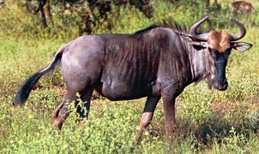
Blue Wildebeest
|
| Scientific classification |
| Kingdom: |
Animalia
|
| Phylum: |
Chordata
|
| Subphylum: |
Vertebrata
|
| Class: |
Mammalia
|
| Order: |
Artiodactyla
|
| Family: |
Bovidae
|
| Genus: |
Connochaetes
Lichtenstein, 1812 |
|
|
|
|
|
|
Species
|
Connochaetes taurinus
Connochaetes gnou
Connochaetes taurinus cooksoni
Connochaetes taurinus albojubatus
Connochaetes taurinus johnstoni
|
The wildebeest ( pl.: wildebeest or wildebeests), also called the gnu ( pronounced /nu/ or /nju/), is a large hooved ( ungulate) mammal of the genus Connochaetes, which includes two species, both native to Africa: the Black Wildebeest or White-tailed Gnu (C. gnou), and the Blue Wildebeest or Brindled Gnu (C. taurinus). The gnus belongs to the family Bovidae, which includes antelopes, cattle, goats, and other even-toed horned ungulates.Wildebeest grow to 1.15–1.4 metres (3'9"–4'7") at the shoulder and weigh between 150 and 250 kilograms. (330 and 550 pounds) They inhabit the plains and open woodlands of southern Africa, especially the Serengeti. Wildebeest can live for more than 20 years.The principal foodstuff of wildebeest are grasses. The seasonal nature of the African grasslands forces wildebeest to make annual migrations. The main migration is in May, when around 1.5 million animals move from the plains to the woods; they return in November as summer rains water the plains. The cows will calve in summer, on the plains. The calves can walk within minutes, and after a few days can keep up with the rest of the herd. After calving the breeding season begins. Dominant bulls defend territories marked with feces and pheromones produced by scent glands on the hooves. Subordinate males form bachelor herds.Wildebeest are an important part of the plains ecosystem. Their dung fertilizes the ground and their eating and trampling encourage new growth. They are also an important food source for predators such as lions and hyenas.
 Jump to Page Contents Jump to Page Contents
|
|

Pay as you go
No monthly charges. Access for the price of a phone call
Go>
Unmetered
Flat rate dialup access from only £4.99 a month Go>
Broadband
Surf faster from just £13.99 a month Go> |
Save Even More
Combine your phone and internet, and save on your phone calls
More Info> |
This weeks hot offer
 24: Series 5
In association with Amazon.co.uk £26.97 |
|
Contents
Name
Blue Wildebeest Subspecies
Media
Name - Contents
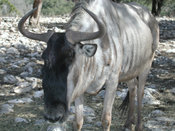 Wildebeest at the Wildlife Ranch in San Antonio, TX.
The name wildebeest comes from the Afrikaans and means "wild cattle" from the bovine appearance of the animals.'Gnu' is from the Khoikhoi language (which pronounced the g), which likely imitated it from the grunt-type noise that a wildebeest makes.The pronunciation of '/gnu/' was popularized in English by the comic song ' The Gnu' by Michael Flanders and Donald Swann, in which all words starting with n have a g prepended: 'I'm a g-nu, I'm a g-nu, the g-nicest work of g-nature in the zoo.'The g is pronounced in German, Swedish and Danish.
Blue Wildebeest Subspecies - Contents
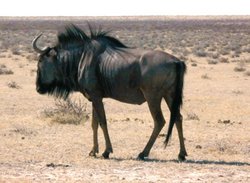 A Blue Wildebeest grazing in Etosha National Park, Namibia
Five subspecies of the Blue Wildebeest Connochaetes taurinus have been described
- Connochaetes taurinus taurinus - Blue Wildebeest (Brindled Gnu)
- Connochaetes taurinus albojubatus - Eastern White-bearded Wildebeest
- Connochaetes taurinus cooksoni - Cookson's Wildebeest
- Connochaetes taurinus mearnsi - Western White-bearded Wildebeest
- Connochaetes taurinus johnstoni - Nyassaland Wildebeest
Media - Contents
 |
|
Connochaetes taurinus albojubatus #1 ( info) |
| Video of the Connochaetes taurinus albojubatus at Disney's Animal Kingdom. |
|
Connochaetes taurinus albojubatus #2 ( info) |
| Video of the Connochaetes taurinus albojubatus at Disney's Animal Kingdom. |
| Problems seeing the videos? Media help. |
|
|
Change Text Size:
[A]
[default]
[A] |



 |
|
|
|
|

