
|

|
|
? Saddle-billed Stork |
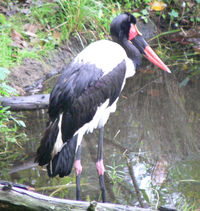
An adult Saddle-billed Stork
|
| Scientific classification |
| Kingdom: |
Animalia
|
| Phylum: |
Chordata
|
| Class: |
Aves
|
| Order: |
Ciconiiformes
|
| Family: |
Ciconiidae
|
| Genus: |
Ephippiorhynchus
|
| Species: |
E. senegalensis
|
|
|
|
|
|
|
|
Ephippiorhynchus senegalensis
( Shaw, 1800) |
|
|
The Saddle-billed Stork, Ephippiorhynchus senegalensis, (also known as the "Jabiru Stork"), is a large wading bird in the stork family, Ciconiidae. It is a widespread species which is a resident breeder in sub-Saharan Africa from Sudan, Ethiopia and Kenya south to South Africa, and in The Gambia, Senegal, Côte d'Ivoire and Chad in west Africa.This is a close relative of the widespread Asian Black-necked Stork, the only other member of the genus Ephippiorhynchus.The Saddle-billed Stork breeds in marshes and other wetlands in tropical lowland. It builds a large, deep stick nest in a tree, laying one or two white eggs weighing about 146g each. It does not form breeding colonies, and is usually found alone or in pairs. The incubation period is 30-35 days, with another 70 - 100 days before the chicks fledge.This is a huge bird, typically 150 cm tall with a 270cm wingspan. Females are distinctly smaller than the males. It is spectacularly plumaged. The head, neck, back, wings, and tail are iridescent black, with the rest of the body and the primary flight feathers being white. The massive bill is red with a black band and a yellow frontal shield (the “saddle”). The legs and feet are black with pink knees. Sexes are identically plumaged except that the female has a golden yellow iris, while the male's is brown. Juveniles are browner grey in plumage.Like most storks, these fly with the neck outstretched, not retracted like a heron. They are silent except for bill-clattering at the nest.The Saddle-billed Stork, like most of its relatives, feeds mainly on fish, frogs and crabs, but also on young birds, and other land vertebrates. They move in a deliberate and stately manner as they hunt, in a similar way to the larger herons.
 Jump to Page Contents Jump to Page Contents
|
|

Pay as you go
No monthly charges. Access for the price of a phone call
Go>
Unmetered
Flat rate dialup access from only £4.99 a month Go>
Broadband
Surf faster from just £13.99 a month Go> |
Save Even More
Combine your phone and internet, and save on your phone calls
More Info> |
This weeks hot offer
 24: Series 5
In association with Amazon.co.uk £26.97 |
|




